












Below is a transcript from the recent session at Forward. Prefer to watch the recording? Click here.
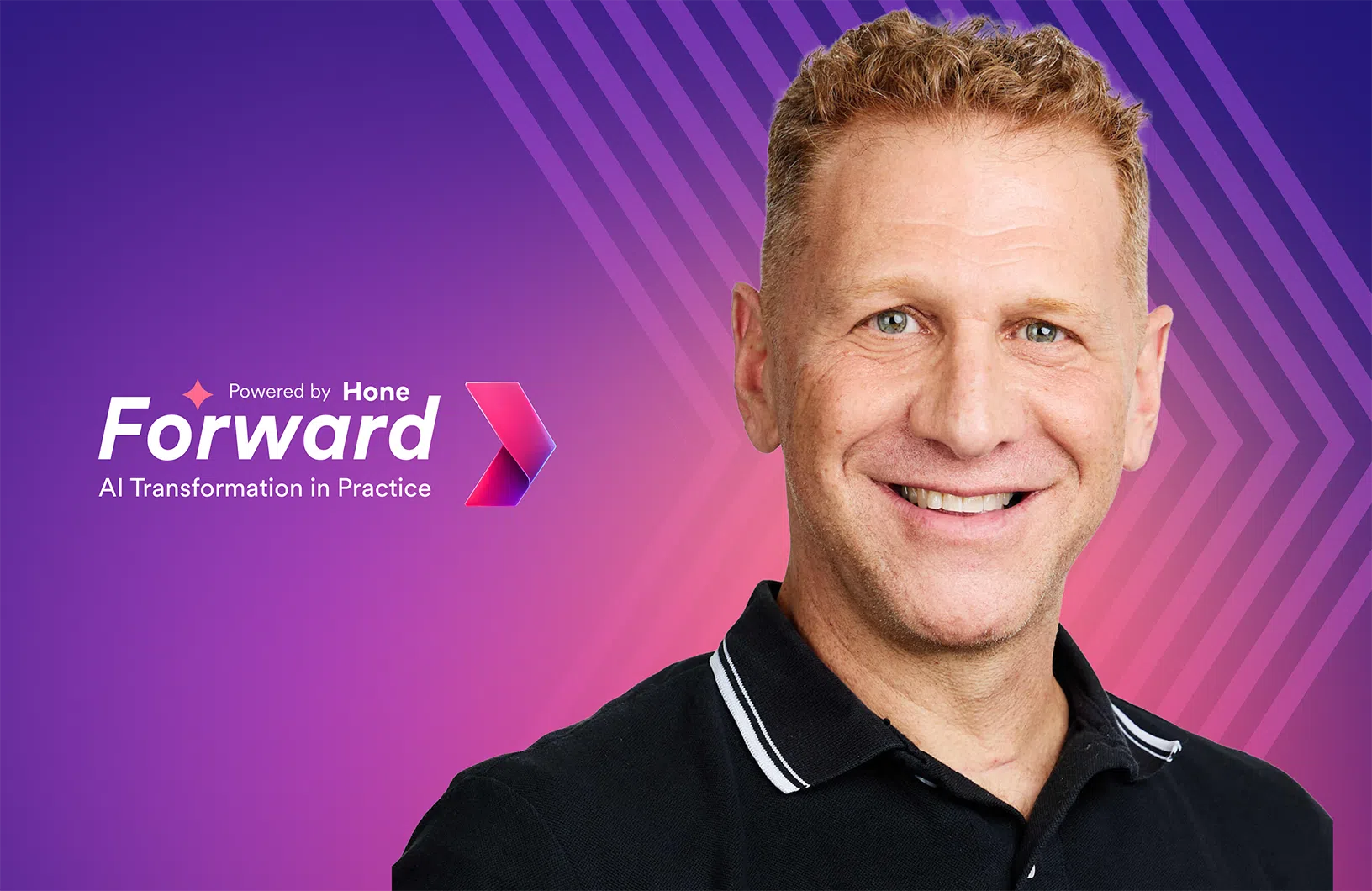
Rea Rotholz; VP of Solutions, Hone: I will do my official introduction. We’ll go ahead and get started. Welcome to our next session at Forward, Make the Machine, Sing and Dance. I love it, Joel, as a title. Practical AI Applications in Keeping the Human in Human Resources. I’m pleased to welcome Joel Greengrass, who currently serves as Chief People Officer at Precision Neuroscience, an amazing company.
Joel has spent more than twenty five years building and scaling people and operations organizations through exciting times, hyper growth, turnaround, and M and A. His session today focuses on where AI can actually earn its keep in HR, not just offloading busy work, but sharpening how teams manage talent and develop people. Joel, we are so excited that you are joining us today at Forward and to dive into this topic. I’ll hand it to you.
Joel Greengrass; Chief People Officer, Precision Neuroscience: Yeah. Thank you so, so much for having me.
Good afternoon, I guess, on the East Coast. Good morning, on the Left Coast. Yeah. So we’re gonna we’re gonna jump in today and talk about practical applications for AI in human resources.
And, really, my thesis is keeping the human in human resources, which is interesting because I’ve spent a lifetime not calling my HR teams human resources, but this is this is the one time to lean into that word human. So, let’s dive in.
We are the music makers. We are the dreamers of dreams.
So this has been my favorite quote for the longest of long times. It’s Willy Wonka. I should note the Gene Wilder version, the only version that matters, but quoting Arthur O’Shaughnessy. And Arthur O’Shaughnessy had written a poem, basically, as we were going from industrial age one to industrial age two. And what he was trying to say was that the the the factories are not really the point. It’s the people.
It’s the imagination. That’s what moves the world, not the machinery. And my argument, if that we wanna call it that today, is really when we think about AI and human resources, the technology is the factory, but we are still the music makers. We are the ones who are setting the trends, setting the direction.
So, everyone keep that one in mind. If you haven’t seen the movie, go back and watch it. It still holds up amazingly well over time. So true story.
Someone at my company, when I was trying to figure out where do I get started with AI beyond just chat and writing, I was begging people to help me. And I went to our director of machine learning, and I said, do you know how to use co work? Do you know how to use coding inside of Claude? And her response was, I can make Claude sing and dance. I’m pretty sure I chuckled. I probably nodded politely.
I actually don’t think I knew what that could possibly mean.
For people who are on on the call who know me, Joel, sing, and dance are never used in the same sentence unless it’s Joel can’t sing and dance, but I had no idea what this meant relative to technology. I really didn’t get it, but I get it now. And there was really one thing that changed that. It had nothing to do with my technical ability. It was really about my curiosity about my own work. So, for starters, I’m going to try and highlight points to take away from on all of this, but one of them is like intellectual curiosity is maybe the biggest superpower that we all have. And it doesn’t matter if you’re in HR or in a different world, but it really is curiosity about your own work is how you improve.
So we know that Claude, ChatGPT, any AI engine can write a job description. It can draft an email. It can summarize a meeting.
It can transform three incoherent bullet points into a memo that somehow now contains 17 paragraphs and the phrase strategic alignment six times. The point is, though, if your AI use begins and ends with writing, you’re standing in the lobby of the Ritz Carlton admiring the floor and missing out on everything else going around you on around you. So when you think about the reason to keep walking and to look around and to go to the upper floor is like, in our world, it’s what are the problems in our work that are not writing problems? Like, I’ve had times where I didn’t write the best email. I’ve had times where it took me a little while to start writing something.
I don’t think I’ve ever defined writing, though, as a problem that’s gonna change the way that I do my job, that’s gonna create a better experience for our employees at the end of the day. So, you know, you wanna make sure that you’re focusing on the problems that that are real, and those are things having to do with consistency, memory, attention.
So I have said this a bunch of different times, and it’s not meant to be ominous. It sounds it a little bit, but, you know, if you remember when when AI first really hit us and came on…
You know, took us by storm. And even I would say last year, was at a number of the bigger HR conferences. I would say half the people there were terrified that AI was gonna take their job. So I tell people all the time, like, you’re not gonna be replaced by AI.
You’re gonna be replaced by somebody who knows how to use AI. That should trigger your intellectual curiosity. That should be why you are diving in here. So to me, it’s…
We don’t need to become software engineers. I mean, that’s not…
Like, let’s face it. That’s not after working for thirty five years, suddenly becoming a software engineer is not in my future. However, curiosity, like I said, that is really the entry fee for all of this. You have to be curious.
And then thoughtfulness is what separates a demo from a tool that people actually use. And then the discipline, that’s where we’re uniquely responsible because we hold the decisions that change people’s lives. And I want to pause there for a second because I think for everybody who’s on here who’s in or a part of the HR community, we don’t get enough credit for this from people around us. I don’t think we give ourselves enough credit for this.
What we do is really, really hard, and it has real like, life consequences, and that is physically, emotionally, and mentally taxing. So, you know, stop for a second, take a deep breath, pat yourself on the back. Like, we are all doing amazing work at a time when I think it’s harder and harder and harder to to to be where we are.
If you are sitting here right now and you’re worried that you’re behind already, the fact that you’re sitting in a session is intellectual curiosity. So you’ve you’ve checked off that first box.
So AI should never replace the human and human resources. Again, like, that is my thesis. I will say it over and over and over again.
If you were all to take a step back right now, close your eyes, and think about the week that you’ve had last week, this week, what you’ve got going forward next week, how much of it was spent with human beings? How much of it was spent assembling information about human beings so that someone else could look at it? So administrative drag is not a neutral cost. It’s a thing that leaves us with no time, no energy for the conversations that really, really matter.
And I think one of the magic tricks that we have to do every day is a company announces something, 15 people come to you with the same exact concerns about that, and we’re by the third person. We’re like, oh god, again, someone’s bringing this up. For each of those people, it’s the most important conversation that they might be having that day, and it’s our job to treat it as such. So when you think about the cost of things that are replicated and are happening over and over and over again, it’s something that builds and it accrues in a bad way in our system.
So we have to make sure that we are creating enough time to keep the human in human resources. So this is a shift that really, really matters. I think most people’s journeys begin and stay in the left hand column, and I think and hope that that’s changing over time, but the left hand column’s like a vending machine. You put in a prompt to get out a paragraph.
It’s not a bad thing. I’m not saying that it doesn’t have value. I’m just saying it’s not what AI is built for and it’s not, it doesn’t even scratch the surface of what AI could do. Like the idea is that as a co worker on the right hand column, we can build tools that are not generic.
They’re not built by somebody who’s never met our employees or understands our companies, understands our values, understands our competency matrices, or sat through any of our talent reviews.
Company specific tools designed around the work that you actually do, that’s where the singing and dancing starts to come in. Because this is when I stopped asking it for paragraphs and I started trying to build things. I should mention, like I am not trying to pass myself off as an AI expert in any way. My goal here is to share my experiences. I know that some of you are probably way ahead of me, some of you are probably a little bit behind me, but the goal is the more we share, the more we learn from each other, and I think that we all get better at this.
So I started building and I started building a lot, and this slide, even since I started putting this presentation, has increased rapidly.
This is just a subset of skills that are company wide at Precision. I’ll dive into a couple of them right now. And there’s a difference though between a skill that sits on your desktop and a skill that everybody can use, and there’s a different way of thinking about the design and the security of those.
But these are skills that everybody in the organization has access to. So let’s dive into a couple quickly. The first is skip levels.
So I found a lot of newer managers didn’t know what a skip level was. Employees didn’t know, how to prepare for a skip level. And when I talked to people who were having skip levels, it didn’t seem like there was a lot of value coming out of them. So the idea was… So one of my other big things is like be the CEO of your own career, and the way in which we do that is we give people tools to do so. So this allows an employee who is preparing for a skip level with their manager’s manager. It also works for regular one on ones, by the way, but they basically can go in, it will walk them through a series of questions and prompts that are, again, specific to their role, their department, the values, the mission of the company.
If the person is also a manager of people, the system knows that and it will also go into our leadership and management competency matrix.
And basically it helps you prepare and send something to the manager ahead of time, And it’s action oriented. It will grill you if your answers are not good because the idea is it’s trying to make you have very specific desired outcomes for your skip level meeting.
And this has been used a lot really, really, really quickly, more so than, I was expecting. And I think one of the learnings there is there’s a lot of things that we as people, people have seen over and over and over in our careers, and we probably take them for granted, don’t because I think people, especially newer managers, they don’t know what they know and they don’t know what they don’t know. So this is a tool that has been used both by managers and employees to prepare.
Radical Candor. This is an interesting one because it started as a class. It started as a webinar that I did in the company based on the amazing Kim Scott book. And the whole idea was teaching people how to give feedback that lands. And you realize that feedback, it’s one of the oddest things, I think, in human nature because as humans, we hate giving it or we struggle to really, really give detailed feedback that would fall into radical candor. And on the other side of the coin, most people have a problem receiving feedback. So after the class, I created this skill and basically people can go in, say, hey, I need to help Joel understand that what he did in this situation wasn’t ideal.
It will ask you a lot, a lot of questions. The first couple of people who used this got back to me and they were like, I was like ten, fifteen minutes in and I was a little bit frustrated because it was a different direction than I had planned going in, And by the time I was done, it came up with something that I hadn’t thought of at all. And it doesn’t just give you like, hey, here’s how to deliver a piece of feedback. It will actually create a one page narrative for you.
Now, as with everything AI, don’t just take that one page narrative and go like sit with someone and read it to them. Like you still own the output. Like that’s one of the things with AI.
It doesn’t matter if Claude creates it, ChatGPT creates it, you own that output and you are responsible for the output.
There’s no mulligans. There’s no, oh, it was just a draft. So if you’re using it for something like this, you want to make sure that it’s accurate and it resonates. But thus far, again, the feedback has been amazing on it.
The next one is something we’re a talent review. So when you go through like calibration exercise with your C suite or leadership team, basically what we did was create a skill where a leader could go in, it knows everybody who’s on your team, it understands all of the competency matrices for team. Again, understands if you’re a manager of people or not.
And the idea is that this is something that does not happen, I would say consistently, in both timing and approach when you think about what’s going on and how you’re doing this as a leadership team. So every leader had to go through and do this. It knew who was on their team and asked them about it. Our three by three matrix, when we look at performance and potential, potential is not good or bad in our example.
Potential is breadth versus depth. So it borrows from the Korn Ferry methodology, and basically it will ask you for each person on your team, where are they performance? Where are they potential? Where are they in readiness for their next role?
And then the really, really nice thing about it was when I sat down with the C suite, we’re able to sort it live. So each C suite member could walk through, maybe it was one sub department of theirs under a manager, we started by clicking on here’s who the people are being promoted. It’s showing the narrative that they entered next to it, so you’re not just giving like one through three, one through three, you’re giving a narrative that goes along with it, and Claude is coming back and actually pushing you on it, including if the narrative is inconsistent with the score. I think the other thing is that you’ve got some leaders who, you know, nobody is at the top level.
We don’t use, like, meets expectations and things like that. We use assist, do guide, lead, so it can be very specific to what a person is able to do in a role. And if something that you’re saying does not compute with the competency matrix that’s in there, it will push you on that and say, listen, this doesn’t seem to connect, and it’ll ask you a series of questions to get get you there. We went through the entire organization, I would say in about an hour, hour and ten minutes, and it was some of the most fruitful conversations that we’ve had because we weren’t focusing on the process.
We were focusing on the actual information. And again, it wasn’t…
The system’s not telling you where people should go, but it’s pushing you on how you’re making that judgment. So I think super, super important, 125 person organization, and we got through it pretty quickly.
So it helped us move the needle in not only how we look at our talent, but also how we decide where and how we’re going to invest in talent.
So efficiency is part of the result, but that’s not the only result.
What we’re looking for is consistency. At the end of the day, we’re human beings, and no two people do things exactly the same. But from a fairness standpoint for employees, consistency is really, really, really important.
And I’m sure you’ve all been through talent review cycles where one manager had everybody on their team as exceptional and another manager nobody even met expectations. Then you’ve got people who are in between, like not fair to the employees. So how do we create a tool that is not a template for the managers, but it’s actually like the guardrails and it walks them through the process for how to get there? And it helps us with our memory, things are not lost.
And I think the idea, when I think about AI, what it helped us do here was it helped us think better. So again, I think intellectual curiosity is what fueled this. My dirty little secret is that I’ve become a nerd.
My family would probably say that I always was, but now I’m, like, really, really a nerd because this is fun. Like, I will literally go, you know, upstairs on a Saturday. My wife will be like, what are you doing? I’m like, I have to go do something with Claude because an idea just came into my mind.
And I definitely love playing with it when I do have ideas. So the value here is not that we care less. We’re using AI as a force multiplier for care because we’re humans, like recency bias. I remember the employee spoke to us yesterday.
Or when you think about reviews, I I remember the project you did last month. I might not remember the project you worked on in January or a commitment that I made earlier in the year. So this doesn’t make us uncaring. This is what makes us human, but this is also an important part of the process if we want to, again, use AI as a force multiplier.
So I think if you are really thoughtful about AI, what it does is it helps compensate for our limits as humans.
I do a lot of one on ones. In fact, all of my time spent or time saved from creating skills, I’ve poured back into one on ones. But I have a one on one tool that I’ve created where I log all of my one on ones, and it will remind me that, hey, you haven’t spoken to someone in this department in the last forty five days, or you haven’t spoken to this person in the last three months. So there’s this opportunity to remind me, don’t just focus on the people who are loudest or the people who sit closest to you or we’re geographically spread out and we have offices, we also have some remote employees. It’s reminding me to make sure that people are getting fair time.
And again, I’m not leaving them out because it’s intentional. It’s just I’m doing what’s in front of me and like most of you, my plate runneth over. So this is a great reminder, and it helps, it it helps cure some of that, like, inconsistency. The other thing is you all have employees who are quieter and employees who are louder, so this enables you to not forget the people who are are are the quietest.
So I swear to God, if I exit right now, you will see that all of the questions are listed one, two, three, four, five, six. Every time I go into this is kind of crazy. It shows all ones, but the question that most people ask is what can this write for me? And this is really where the world…
The the the real work begins. Right? Like, it’s not automation for automation’s sake. The objective here for me is better…
We’re we’re the people team. So better better people team, better human resources, better engagement. So the questions are that you should be asking, what work are we repeating? Where are managers struggling?
Which decisions lack consistency? What knowledge lives in one person’s head but needs to be shared? Like, where do we create that learning loop? This is one of the things that this whole what forward is about.
What commitments are we failing to track? Which employees receive less intention because they don’t demand it? Where are we collecting information instead of understanding it? And which process creates so much administrative drag that we don’t have time or energy left for the human conversation at the end?
So when you think about these, if you can’t answer these questions, a tool is not going to save you. So really, this is the place that you have to start.
So make it sing. I’m corny, so I had to come up with an acronym. So start with a human problem, infuse it with context, never outsource judgment, and give time back to people. And I’ll get into these a little bit, each one. So do not begin with the technology. If you start building a tool that you’re looking to the tool to build instead of trying to solve a problem, usually you’re going to get an impressive demo that nobody uses. What we’re trying to do is create something that raises everybody’s ability.
I always say that the managers are really the human resources department. They’re the ones with their people all day. They’re the ones who are dealing with problems, challenges, keeping people on track. But we need to give those managers the tool to be able to do it. So if you have a clearly defined human problem, then that’s where you can create the possibility of meaningful improvement. If you start, again, if you start with the tool, you can come up with some cool stuff, but you’re probably not going to get with something that is going to move the needle for people.
Infuse it with context. So generic AI produces generic output. So every tool that we have has every competency matrix. It’s got my full organization in there. It’s got our values. It’s got our mission.
Our competency matrices are built along that assist, do, guide, lead as well. So every department has competencies. Leadership and management has their separate set of competencies.
It needs to know your company, right? It needs to know who you are as a company if you want it to be specific enough where it doesn’t sound like a generic type of tool.
And then again, never outsource judgment. I don’t know if people saw this, but Ernst and Young last week or the week before announced a bonus pool for people who are basically showing human judgment, human decision making.
And it’s interesting because Ernst and Young, if memory serves, they leaned in pretty hard to AI at the beginning, and now what’s happened is they’ve been getting a lot of slop, and they’re trying to make sure that people go back to being the people and the smart people that they hired them for. So again, from what it can do, it can organize your information. It’s great at identifying patterns. It’s one of the things that I love the most. Challenge reasoning. I have in my tone document for Claude that I am a liar and that it is to push me until I can come back with multiple sources for every answer, so it will challenge my reasoning.
It will give me options. It will help me prepare. I think the one thing that’s really, really important for people to understand and remember is that you can’t outsource the judgment. It’s also it hallucinates and it’s wrong. If people didn’t see the recent Mount Shasta issue where hikers got stranded, take a look. That all came from AI.
My goal is with the G is give time back to the people. So if you’re saving time and it’s not going back towards the people, then what did you actually accomplish? So to me, it’s for everything that I do, I pour it back into interpersonal relationships with folks because I think that’s where the value is in what we do. So it’s an amazing thought partner. It’s not a substitute for me. Like I said, it can be magnificently and confidently wrong.
I want to jump through here quickly.
I went back and I looked at what was the first skill I ever used in Claude, and I found this. This is what I created. Why is that? I think it’s probably because it was the lowest risk that there was for me, and I guess I was supposed to show it because it actually had the same color backgrounds that we’re using today, so I leaned into that. But the singing and dancing, again, it didn’t come from technology. I understand now it came from imagination, intellectual curiosity, context, knowing our work well enough to see what could be different.
So I invite you to all go make the machine sing, make it dance, and then close your computer and go talk to a human being.
And that’s it.
Thank you so much.
Rea: Thank you, Joel. I don’t think it’s a coincidence that the first AI thing you built was a dancing character.
Right.
Is a wild coincidence. Really powerful. I mean I do wish we had more time because this was a really powerful session with such amazing tactical takeaways that HR leaders can leverage right away. So thank you so much for that Joel, we really appreciate it. We are now going to hop into a short break, so grab a snack, stretch, when you’re back we have another exciting panel all around CHROs.
CHROs are now at the table for AI strategy, governance, and risk in a new way. So we are joined by leaders from Lattice, Tactical, Amplitude, and GumGum, and we’re going to learn from them. So go ahead and take a quick break, and then we’ll see you in the next session. Thank you all for coming, and Joel, thank you again for leading It was wonderful.
Joel: My pleasure. Thank you again.


