












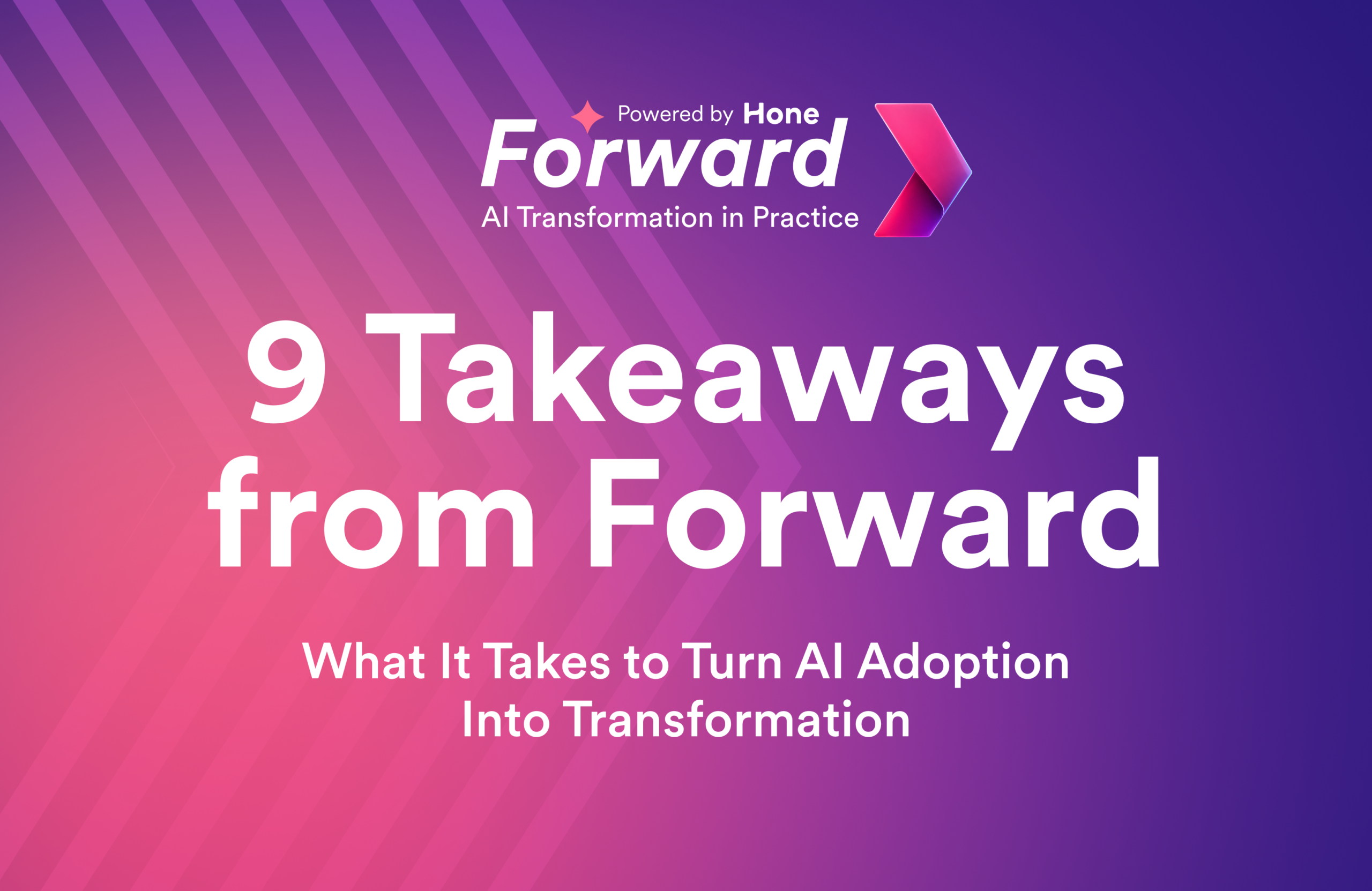
More than 1,000 HR, L&D, and Transformation leaders recently joined us for Forward: AI Transformation in Practice to explore a question nearly every organization is wrestling with right now:
What does it take to move from scattered AI experimentation into lasting transformation that changes how work gets done at our organization?
Across nine keynotes and panels, leaders from GitLab, Rippling, Greenhouse, Lattice, ModMed, Progyny, Fabletics, Docebo, Amplitude, Vanta, and more shared how they’re tackling this at their organizations, what they’ve learned from helping their teams build AI fluency, and what they’re focused on next.
And while the day was about AI, the biggest lessons weren’t really about the technology. They were about the people who make up our organizations: how they make decisions, how they lead, how they build trust, and how to create the conditions for them to work differently.
Read on for the nine big ideas that stayed with us from the virtual conference:
1. AI transformation is leadership transformation
Introducing new technology is only part of the challenge. The bigger shift is changing how people lead, make decisions, and work together.
William Feng, Global Head, Learning & Leadership Development at Fabletics, summed up the connection between AI and leadership:
AI transformation is not just about technology, it’s leadership transformation.
Managers are at the center of this shift. They’re being asked to help employees experiment with AI, rethink workflows, exercise judgment, and navigate constant change, often while figuring those things out for themselves.
Jamey Dubke, Vice President, Head of People at American Health Staffing Group, captured the change well: managers no longer create value simply by being the person with the most information. Their value increasingly comes from helping their teams make sense of information and turn it into action.
For organizations investing in AI, manager development can’t be an afterthought. It’s part of the transformation strategy itself.
2. AI adoption and AI capability are not the same thing
It’s relatively easy to measure whether employees are logging into an AI tool.
It’s much harder, and much more important, to understand whether they know how to use it well.
During her keynote, Czarina Ramsay, Leadership & Capability Strategist, challenged organizations to think beyond tool training:
Training people to use a tool is not the same thing as building capability.
True AI fluency requires more than prompting skills. Employees need the judgment to determine when AI is useful, how much context it needs, how to evaluate its output, and when not to use it at all.
Organizations that fail to invest in transformation beyond driving tool adoption will never be able to meaningfully change performance. The goal should be to build leadership and employee AI capability that improves how work gets done.
3. Start with the problem, not the technology
It’s tempting to begin incorporating AI into your HR processes with the question, “What can we automate?”
Joel Greengrass, Chief People Officer at Precision Neuroscience, suggested a better place to start: the problem you’re trying to solve.
He shared his SING framework for approaching AI automation:
- Start with a human problem instead of technology. What’s the frustration you want to solve for?
- Infuse it with context. Give AI the details it needs to better understand your organization, such as your competency matrix or values.
- Never outsource judgment. AI is great at organizing and synthesizing information, challenging reasoning, and helping us prepare. But it should never be used to make decisions that require human judgment.
- Give time back to people. Joel says “efficiency isn’t the final result.” The time saved should flow back toward human connection.
The framework is a useful reminder that an AI workflow is only valuable if it solves a meaningful problem. And even when AI is involved, accountability still belongs with the person using it.
As Joel emphasized:
You own that output and you are responsible for the output.
4. Measure business impact, not AI activity
Many organizations are still using AI adoption metrics as a proxy for success:
- How many employees have access?
- How many are using the tools?
- How frequently are they using them?
Those metrics can tell you whether adoption is happening. They don’t necessarily tell you whether AI is creating value.
For Ariana Moon, VP of People Transformation at Greenhouse, the real measure of AI’s success comes down to its impact on the business:
Are you helping create dollars, save dollars, reduce risk, spark innovation?
The next generation of AI measurement will need to connect usage to meaningful outcomes, whether that’s productivity, quality, customer impact, innovation, employee experience, or something else entirely.
The question shouldn’t simply be, “Are people using AI?” It should be, “What is different because they are?”
5. AI change champions aren’t always your most technical employees
AI change champions are employees who help drive adoption from the ground up by encouraging experimentation, sharing what’s working, and helping peers navigate new ways of working.
Shana Storey, VP, Talent Development & Organizational Effectiveness at Progyny, and Carlin Sheridan, Director, AI Enablement & Adoption at Progyny, shared how, as they were building their AI change champion program, they realized that the best champions may not be the people with the deepest technical expertise. They’re the employees who are trusted by their peers, curious about new ways of working, and enthusiastic about helping others navigate change.
That distinction matters.
AI transformation is as much a behavior change challenge as it is a technology challenge. Champions need enough AI fluency to help others, but they also need credibility, influence, and enthusiasm to bring colleagues along with them on the transformation journey.
6. Employees need space to learn out loud
There is no perfect roadmap for becoming an AI-first organization. That means companies need to create room for experimentation, learning, and iteration.
During his session, Zach Ward, Senior Director, Learning & Leadership Development at ModMed, shared that one year ago, many employees were already experimenting with AI, but doing it quietly, afraid to share wins or even ask basic questions. ModMed responded by creating dedicated space for people to learn together through Slack channels, micro-challenges, and shared experimentation.
The message to employees was simple:
We gave everyone explicit permission to play, to mess up, and explore together.
The result was a shift from isolated experimentation to visible learning and skill-building, with AI wins and role-based use cases going viral across the organization.
7. HR’s mandate can look completely different in today’s workplace
AI transformation is no longer just an IT or Engineering initiative. It requires close partnership with HR to reshape roles, define guardrails, equip employees, and change how organizations operate.
During the panel, “How AI Is Changing the CHRO’s Mandate,” KJ Johnson, CHRO at Amplitude, shared how deeply her team has moved into building and experimentation:
We actually shut down the company for an entire week… Everyone was expected to spin up AI, build agents, experiment. We didn’t care if it worked. We didn’t care if you broke things.
Her People team now has an AI Center of Excellence and has built multiple AI prototypes themselves, a sign of how quickly the function is moving beyond simply supporting transformation to actively shaping it.
Katey Ross, CHRO at Tactacam, emphasized how building AI fluency within HR can help the function better support business priorities:
Through our team getting upskilled and super smart in AI, we can meet those leaders where they are and accomplish those priorities.
The takeaway: HR’s role isn’t just to manage the people impact of AI after the strategy is set. It is to set the vision alongside executives to build capability, redesign work, shape workforce decisions, and help determine how AI gets put into practice across the organization.
8. AI transformation requires different people to play different roles
In their keynote, Tom Griffiths, Founder & CEO of Hone, and Rea Rotholz, VP Solutions at Hone, argued that AI transformation can’t sit with one function or one group of employees at a company.
Instead, it requires six distinct groups across the organization to play different roles:
- Employees need to build the fluency and judgment to work effectively with AI.
- Managers need to translate strategy into new ways of working and help their teams navigate change.
- Executives need to set direction and create clarity around what transformation means for the business.
- AI builders need to turn real business needs into useful workflows and systems.
- AI change champions need to create momentum and help new behaviors spread from the ground up.
- Strategy & governance leaders need to create the guardrails that enable responsible experimentation.
The challenge, Tom emphasized, isn’t necessarily finding these people. It’s being intentional about how organizations develop and bring them together:
You already have these people in your organizations. The point is, let’s be intentional about recognizing them, cultivating them with the right communities and development experiences, and then coordinating them within the broader change strategy.
9. Manager development has to happen in the flow of work
Traditional manager training often asks leaders to step away from their day-to-day responsibilities to learn — then leaves them to figure out how to apply it later.
In his session, “A Framework for Developing Managers in the AI Era,” Josh Zimmerman, Senior Director, Talent Development at Kong, shared a different approach: use AI to reinforce specific leadership behaviors in the moments they actually matter.
Kong built an AI-powered manager development loop that starts with employee engagement data, identifies the specific behavior a manager needs to improve, then delivers targeted nudges, practice, reflection, and follow-up over time.
Josh emphasized the importance of reinforcing learning beyond formal training:
There’s a place for formal learning, and there’s also a place for building habits, and you build habits by learning in the flow of work.
That approach translated into behavior change: during the pilot, 54% of managers who had recognition as an area to improve gave public recognition during the program.
The takeaway: developing managers isn’t just about giving them more content. It’s about helping them practice the right behaviors, in context, repeatedly enough for those behaviors to become habits.
The biggest takeaway: AI transformation is a people challenge
Across every session at Forward, one message came through clearly: the organizations that make the most progress with AI won’t necessarily be the ones with the best tools. They’ll be the ones that equip their people with the skills, judgment, and confidence to put those tools to work in meaningful ways.
That means developing managers differently, giving employees room to experiment, building communities of change champions, and measuring impact beyond adoption. It also means giving HR a seat at the table to help shape how AI transformation unfolds across the organization.
Hone CEO Tom Griffiths brought that idea into focus during his opening keynote:
The AI transformation constraints that we might be facing in our organizations aren’t about technology. They are about the people who are using the technology.
The opportunity ahead is to turn that understanding into action, building the capabilities, habits, and culture that will help organizations adapt and thrive as AI continues to evolve.
Missed Forward or want to revisit a session?
Watch all nine keynotes and panels on demand to explore more of the practical ideas, frameworks, and real-world examples shared throughout the day: https://honehq.com/forward-ai-transformation-in-practice-on-demand/


