












AI adoption is easy to track. Measuring its impact is another story.
As AI becomes more embedded in everyday work, HR and L&D leaders need to look beyond logins, licenses, and usage rates to understand how AI is influencing employee performance, strengthening leadership, and driving meaningful business outcomes.
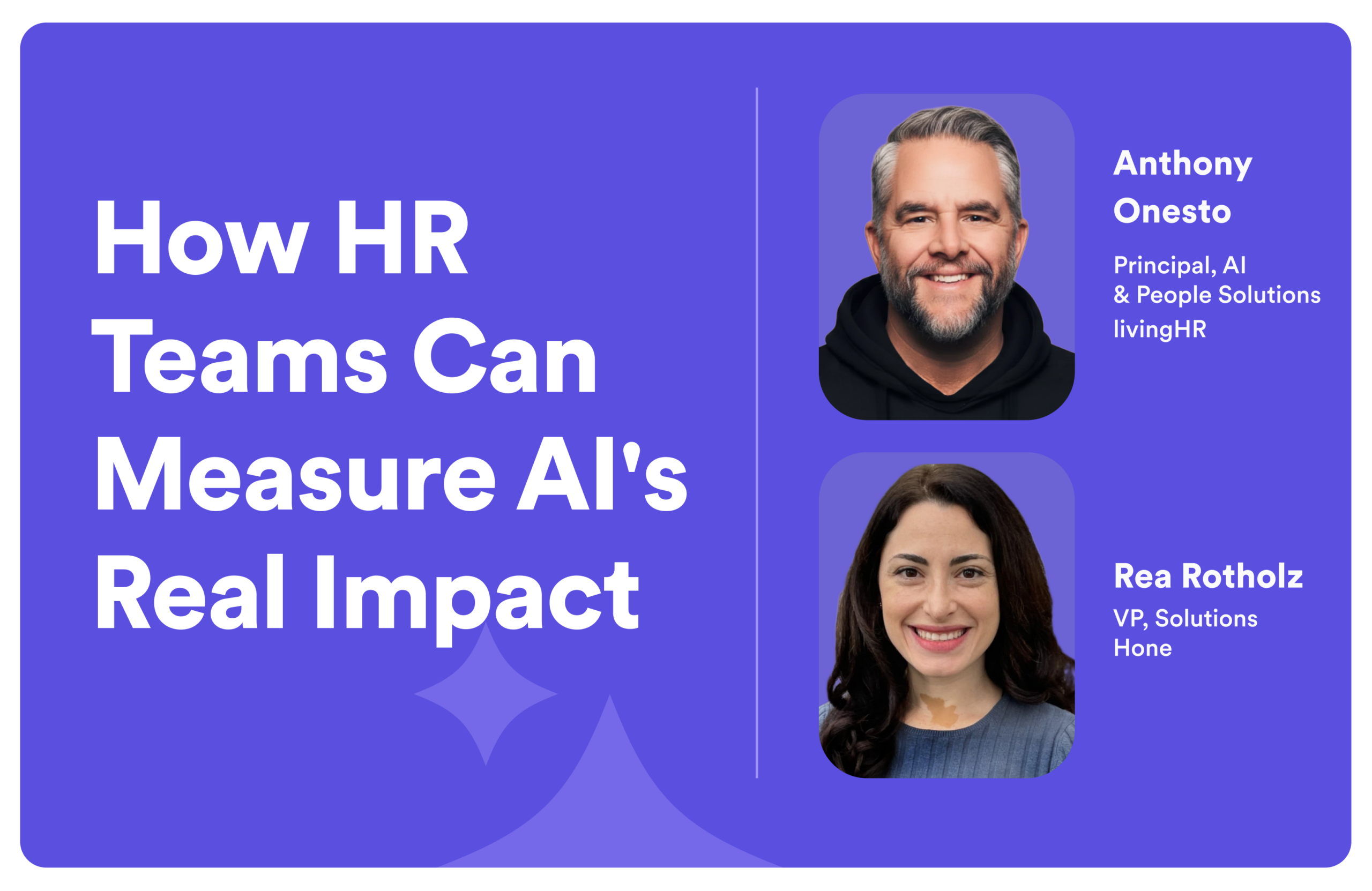
In this webinar, Anthony Onesto, Principal, AI & People Solutions at livingHR, and Rea Rotholz, VP of Solutions at Hone, explore how organizations can better measure the impact of AI, identify skill gaps, and connect AI adoption to the outcomes that matter most.
Watch the webinar recording here or read the full transcript below.
Rea Rotholz: Hi, everyone. I see lots of friendly names here. So good to see you all. I’m Rea Rotholz I’m Hone’s VP Solutions. I partner with our customers to design their learning journeys, upskill effectively, and measure the impact of that upskilling.
And I have been with for five years now in this role. Prior to joining Hone, I led learning and development at Dow Jones. So I was in house L and D before coming over to the vendor side. And then prior to that, I was in various consulting roles. So really excited about today’s topic.
And I will pass it to my partner in crime here for today. Anthony, you wanna introduce yourself?
Anthony Onesto: Love to. Thank you, Rea As Rea said, my name is Anthony Onesto. I am currently principal of AI and people solutions at livingHR.
LivingHR is an HR consultancy firm. We call ourselves the work agency. So like your marketing or your accounting departments, they get to use it outside help when they need it. That’s living HR.
It’s across the entire employee life cycle. We’ll help to build, you know, build fractional support or even manage services support for you. I’m leading our transformation work because I believe AI is a people transformation, not a technology one. And I also believe the HR folks should be owning the transformation in their own departments, in various different departments.
So I’m excited to join Living HR and help build this practice for them.
And we’re doing it for a bunch of customers. We’ll talk about that in a couple of slides. My background, I’m New York based, as I said at the beginning. My background prior to this, I was a VP of product at a company called Fifteen Five, but prior to that, I’ve been in HR my entire career helping to build fast growing startups.
I’ve worked in global large enterprise organizations in an HR capacity, and I’ve been doing this AI work for about twelve or thirteen years way before it became really cool to talk about AI. I tried to actually create an AI chatbot for HR. I failed miserably, but I learned a lot while doing that. So really excited, and this topic is near and dear to my heart because we’ve seen so many different failures in measuring the impact of AI, and a lot of folks are struggling with the ROI.
So hopefully, you’ll take out some some real interesting ways to think about this. So back to you, Rea, but thank you, Greg. So happy to be here.
Rea: We’re so happy to have you. When did you build that chatbot?
Like, how long ago was that?
Anthony: Thirteen years ago. It was called k.ai, and the idea… We we got FMLA down pat. It seems very easy now. I think if I would have kept it, I would have been overtaken by chat GPT over Claude at this point, but but we got the FMLA down pat. Like, so you’d be able to ask it a question on your specific FMLA issue, and it would answer your question.
Rea: That’s awesome. Wow.
Anthony: It was really exciting.
Rea: Now you can spin it up with, like, one Claude prompt.
Anthony: It’s a GPT. Right. Right. Exactly.
Rea: Anthony, you mentioned that you believe that it’s really a people priority, not just a technology priority when it comes to AI transformation. At home, we believe the same thing. I’m curious for those of you in the chat, I told you I’m gonna ask you to participate.
Let’s put a one if HR is really leading the transformation, a two if technology is leading the transformation, and a one and a two if you’re really co collaborating equally on it. So one is HR leading the AR transformation, two is the technology team leading the transformation, or one and two.
I always find it fascinating to see.
Anthony: Yeah. Great question. Great question. A lot of ones. Hey, Matt. I saw Matt commented. Yeah.
We…
Farrell is one of our, principles here at LivingHR. So great great to meet you there, but, yeah, a lot of ones.
Rea: I know a lot of twos, honestly.
A lot a lot of twos, which is perhaps more challenging. Right? Because you might know the importance of the people side of transformation as an HR leader, but you’re not necessarily the one leading organization.
So helpful to see, and also always helpful to see like we’re not alone in whatever our experience is.
Anthony: No, not at all. And it’s pretty common if you think about like two years ago or when OpenAI came out, everyone approached this as a technology transformation, gave out licenses. So you’re not alone. I will say today’s the day you’re gonna walk away and you’re gonna go into your CEO’s office tomorrow and say, I own AI transformation, and we’ll hopefully we’ll we’ll we’ll make it comfortable for you to do that.
Yes. HR, more work. I know. But…
Yeah.
Rea: Okay. Well, that that question wasn’t even planned. So let me just quickly do the Hone intro that I was supposed to do before.
If you’re not familiar with Hone, we help HR and LND leaders build leadership and workplace skills their people need to perform at their best in today’s AI enabled workplace. So as I mentioned, we care deeply about the people side of transformation, particularly leaders who are at the front lines dealing with all of the change and agility required in today’s world.
We do this through live expert led workshops. So live humans in a classroom together, trying and learning together. And we also have personalized AI coaching that helps with the longevity and the reinforcement, etcetera. Hone equips managers, leaders, and teams to navigate change with clarity, adopt AI with confidence, and turn new ways of working into measurable performance gains.
So really excited to be partnering with Anthony, who’s really deploying this from an HR perspective. And I, sitting across our customers, can share what our customers are doing from that people transformation perspective. So it’s a little bit about Hone. And then one more housekeeping item, and then we’ll get into the the into the content, I promise.
But we do have another webinar coming up. So if you are someone who likes to attend our HON webinars, thank you for being here. And feel free to sign up for our next one, which is going to be kind of related topic with Joel. He is the CHRO or chief people officer of one of our amazing customers, Precision Neuroscience, incredible company by the way.
But less admin, more human, practical AI for HR leaders in 2027.
And Sarah will post the, oh, she just posted the link in the chat, so you can go ahead and register for that.
Okay. So let’s get into today’s topic and sort of one of the reasons why we’re here, which is that AI adoption, which we’ve all been driving towards and talking about now for really like two plus years for many of us, does not automatically mean impact.
We’ve been focusing on adoption, but that doesn’t automatically mean impact. HR and L and D leaders often look at the service level metrics like token usage, like who has access, licenses, which tools, etcetera, because frankly, that’s what we have access to, right? Like that’s the easiest thing, that’s the data that we have, and it’s much more complicated to move beyond that. So we’ve been using that as a proxy for impact.
And this is a widely known challenge. It was a big topic at the Gartner HR Symposium for any of you who may have been there, Hone was there, listening to the latest research. And I really just wanted to share some of what they shared since their research is usually really well backed.
So to truly measure AI impact on our employees, but also our performance and sort of business value, we really have to connect how AI is being used in relation to the business value that we’re looking to drive and not just usage in general.
So one of the things that Gartner discovered is that we’re focusing a lot in HR and in organizations on productivity.
Productivity as a proxy for that impact or that value.
But only 3% of organizations really save costs through productivity, which I thought was interesting because we’re using productivity as such a proxy, but it’s not really necessarily leading to that cost savings that we think it might be.
78% of CHROs are also not aligned on where exactly AI creates that value, right? So we’re kind of, again, using the adoption, assuming that that’s creating value. And for those of us that know it’s not, we don’t even know exactly what we’re looking for, right? Like what is the value that we should be looking for? And most CHROs are not fully aware either.
And then finally, 82% of employees are willing to take on more strategic work. People are excited to automate sort of the processes and tasks that they can to free up time, right? But only 21% of that time that’s being freed up, that capacity based on efficiency, etcetera, gets redirected to more strategic work. Most of it is being redirected to answering more emails, maybe taking a break, which is definitely productive, don’t get me wrong, but we’re not really leveraging that productivity gain in putting it towards something really strategic for our business. And I really thought that was fascinating research to understand sort of the state of AI adoption today.
I don’t know Anthony, if you have any thoughts or if you’ve seen any of this with your clients that you work with.
Anthony: Yeah, definitely. Listen, I wanna give folks on the call a bit of grace. This has been a whirlwind. We are at the very beginning stages of this.
I actually just did a talk in Tampa for Disrupt, and I talked about the history of transformation. I talked about electricity. I wasn’t here for that, by the way, although my gray hairs may say otherwise. But the idea that, you know, when electricity was introduced into manufacturing facilities, they didn’t see immediate productivity left.
So we’re we’re at the beginning stages here. So give yourself grace. It’ll feel very forced and urgent because of the news and everyone’s talking about AI, your boards, your CEOs are pushing things down into the organization, but you’ll see in a couple of slides, we have the formula to help you out. So that way you’re not just thinking of it from a productivity lens, you’re thinking of it from your normal business lens, the business metrics that you’re already tracking.
And to think about the usage as a measure is again, a reaction to what we had available as Rea said, but also just sort of the pressures that we got on making, know, like ROI became part of the conversation. It was the only thing we can measure. It’s obviously very faulty, and we’ve seen evidence of that If you’re just tracking, you know, usage or token usage, people are using it personally so they can get up on the leader leaderboards.
And again, we’ve been given the technology and the licenses, but not really given an opportunity to step back and understand where this transformation is gonna happen. But I will say it’ll probably be the most ubiquitous transformation we’ve seen around work since the Internet, since the PC. Maybe not electricity because none of us were there, but at least for those that were there for the Internet, for PC, I think this is gonna be a bigger one. So let’s get, you know, let’s get our arms around it as HR leaders, and I I promise you, we’re gonna be able to get through this together, and it’s a lot of what you’re gonna see us present or see myself present.
You’ve done this work before actually, so it won’t be a surprise. So excited to be here and just give yourselves a little bit of grace. Yeah. These numbers are not great, but they they can be.
Rea: Well, they’re also, like you said, we’re in such the beginning stages. This is really baseline. We haven’t done the work. We’ve been slowly starting, but we don’t know how to do this work yet. And we are frankly all learning together, which is why I think forums like this, where we can come together and talk about what works, what doesn’t work, what we’ve seen is really helpful.
Why don’t you put a one in the chat if you were here when electricity was started? Because that’s, I’m just kidding.
Don’t actually do that, but I thought that was really funny.
So Anthony, yes, let’s move to hearing about how you’ve been approaching this and sharing how you’re thinking about this with living HR. Do you want me to go to the next slide or do you have a setup?
Anthony: No, let’s do it because I think visuals are important. A very visual person when I try to understand something. So again, you’re gonna see here that AI transformation is work redesign and you all have been doing work redesign for, you know, for years now. So none of this should be surprising in terms of one, the methodology, and none of this is proprietary.
Obviously what we bring in is our expertise. We augment your departments when we come in and do this, when I come in and do this, and we’re doing this across multiple different clients right now in different avenues. And we have an example in the slide next about a specific client anonymously, of course, that we’re working with, but at the end of the day, what you need to really start thinking about, so here’s the mistake we made when we did this, and again, give yourself grace and there was a lot of pressure, we gave out licenses and hope for the best. That’s exactly what happened and this transformation is very different And what we need to start thinking about first and foremost, and you can see here in the diagram that we have here, this is our methodology to really dive deep into organizations.
And we do this across not only HR departments, we really do this for departments of all types, but we do it through the HR department, because again, you can see work redesign is an HR capability. It’s within our skill set already, and it’s something that you’ve done. So what we first do is start looking strategic capabilities.
So we don’t even give out the licenses. We don’t even talk about technology in the first couple of steps, because again, see above, this is a people change initiative. We start with the strategic capabilities, meaning what are you trying to accomplish? What are your business goals in the next six to twelve months?
We we don’t we don’t try to even anticipate three to five years anymore, because things just change so dramatically so quickly. So what are the strategic capabilities? What must the business do to succeed in the future? Then what we do is we go deep dive into task unbundling.
So where where we’ve seen mistakes again is that you’re you’re reading on LinkedIn. There’s always this post, and and by the way, just be warned, there’s snake oil salespeople out there that’ll tell you, I I’ve actually have a full department of agents and it’s just me. That is BS. I’m a New Yorker.
It’s my New York French. It’s BS. That’s…
There there is no one job that’s fully autonomous with with an AI agent at this point that I’ve seen. What you need to do is not go at the job level. You need to go at the task level, and what we do is we work with your teams, and I didn’t say this before, but I do want to caveat all of this, and this is why I think this is important to be led through HR. There is a study that was done by a company called Irrational Capital, and they looked at this transformation of AI success in transformation.
Now remember, we have a small window here in terms of our our capabilities. We have a lot more in the future than we do in the past around AI transformation, but they found one thing that was truly important that actually changed the game in terms of AI transformation. It was the one thing that led to successful AI transformation in the companies that they studied. So I wanna ask you, we’ll interactive.
What do you think the one thing was in the biz…
In these businesses that made their AI transformation successful? Throw it in the chat. Just take a guess. It’s okay if you get it wrong.
We’re not gonna be judging you. Throw in one word. What do you think was important element in all of these companies that led to their successful transformation?
So we have leadership support. We have adoption, change management. I love it. I love it.
Keep it coming. Rodney, you’re you’re…
I’m gonna give you a little hint here. You’re close. Absolutely. Buy in. They knew how things were defined.
Change management. Another Kendall. Yeah. Freedom to fail. Commitment. Communication, follow-up. Yeah, all of this stuff.
The mindset, the commitment, the clarity of expectations. Well, I’m gonna give you the answer folks. Keep them coming in. Keep guessing, keep guessing.
I love it. I absolutely love it. Here’s the secret. It’s something we’ve been talking about in HR for about two decades now, and it is what I call a power skill, but most folks, if you go into a boardroom, will feel like you’re talking some soft stuff here.
It is trust and psychological safety. The number one factor across all of these different transformation efforts that was successful is each one of them came with trust and psychological safety. Psychological safety is a US known thing. Trust is more global, so they’re interchangeable, but is the one factor that was important.
So when I talk about starting this work, what we do at Living HR, because we’re part of the HR consultancy world, is we start with that trust and psychological safety. We analyze, you know, what do your engagement scores look like? Do your employees trust you? If they don’t, you’re not gonna really get at the really deep rooted things that AI could be helpful with.
So I wanna set the stage there.
Make sure you have psychological safety and trust because in the news on LinkedIn, everyone’s saying we’re reducing people because of AI, and again, not so much true. And we’re seeing a lot of companies going back to hire people. Alright. Back to the design. So now you’re going in and you’re talking to your people about their tasks. Tell me what you do and not in an office.
I forgot the the name of the the movie, but I think it was The Office or one of those things where they came in and say, you know, tell us what you do, and and this is more deeper. Again, you need to have that trust in psychological safety, but we’re going in and we’re unbundling the task. Now what we do is we teach each one of those tasks, and we put it at the lens of automation.
Can that task be fully automated by AI? Can it be augmented by AI? Think of a electric bicycle, if you will. You have a bicycle, and then you add a little motor to it, so it makes you do things faster, maybe more efficiently.
Or… And this is the last part where I think a lot of people fall down on is what still needs to be remained human. What are the things this webinar… Maybe at some point, there will be a Rea bot and an Anthony bot and an avatar that just talk to you. But right now, we’re humans. We’re real pinch us, and we and we hurt.
This is human. It’s always gonna be human. I don’t think anyone’s gonna ever watch an avatar read webinar. I could be wrong.
But you have to remember what in that task should remain human, if anything. So again, remember, we’re looking at is it augmented by humans? Is the human at the center of it, or is it fully autonomous? And there…
And this is where I think most folks fall down. It’s not one specific job that you could do that. You have to go to the task level. But even before you do that, you really have to understand where are you gonna get the most ROI within that task.
So you also have to put those tasks under a microscope to see what’s feasible and what gets you an ROI. So for instance, if you’re in recruiting and you look at sourcing, we know for a fact that AI can do sourcing really well at at scale.
If you’re taking away the sourcing from your recruiters, what are they doing next? Well, how are you gonna fill up that time? Because we’re suggesting that you don’t eliminate that role, you just repurpose that role. And that’s where partnerships with like a hone come in, where we look at reskilling that particular position.
Because again, the position is not being eliminated. It’s tasked within that position. We’re either automating completely with AI or we’re augmenting that human. So a lot of that skill, you know, if I think of a sourcing type of role in recruiting, maybe you now have to think about teaching that person how to negotiate.
Right? Because now you’re going to offers a lot quicker or how to sell the organization a lot better than than they have. So it dynamically changes the way you think about roles within your organization. Then reskilling, and again, partnership with someone like Hone.
When we’re doing this, we wanna tell our clients, hey, you should go to Hone and get the skill sets that you need now for this this role. Think about the different tasks that if they’re no longer doing, and the tasks you’re gonna need in terms of number one, the strategic capabilities. Then you build in the change. Now I will argue that change comes in in step six, but it’s across all the different stages.
Like I said, if you’re not building change management or trust within your organization, it’s not going to work. So even though it is in step six, and you have to really think about your communications, and your culture, and all that important stuff, And then you could see here org design, which everyone is talking about these days, is the last part of this. Because if you see above, this is not about eliminating role…
Eliminating roles. It’s looking at the task level.
And if you’re taking pieces away from a role and automating that with AI, what does that do for your new organization? How does that change the way you think about building a recruiting department? And where we measure, and I’ll go to Rea, I’d love your thoughts on this, but as as all of this is thought about, we don’t make up fictitious measurements for you to think about. When we think about the ROI of working with living HR, what we look at and what we start out with is the strategic capabilities, but also what are the business outcomes?
Give you an example. In recruiting, time to fill is something you already measure. What we wanna do is look at time to fill before we do this work and then time to fill after. And hopefully what happens is because we’re speeding things up, we’re actually increasing your time to fill or decreasing frankly.
Increasing the speed, decreasing the time to fill. That’s a normal business metric that you want to see is it changed by doing the work within AI? We’re not making up some fictitious AI metric. Don’t not…
Don’t do that. That’s not gonna help you. Rea, any thoughts here? Any thoughts from a home perspective?
Rea: Yeah. I I have a few thoughts, but then I also did wanna double click. Nushka put something in the chat, and I think I’m wondering the same thing. So you mentioned trust, going back to trust and psychological safety, which I feel like in HR, all believe, like we see it in action, right?
But what do you do or what have you seen if you know that an organization doesn’t have that level of trust, but the AI transformation mandate is not gonna go away, right?
How do you tackle both in tandem, I would assume, or have you dealt with that?
Anthony: Absolutely.
Yeah, there’s no perfect organization, even the top 100 best places to work have some level of disengagement within their organization. What you want to do is we’ll do this for you too, is we’ll do a readiness assessment. We’ll take your engagement scores and we’ll identify hotspots of opportunity or not, but we’ll do our own readiness assessment to understand is that having an impact on the potential AI transformation. We’ll put those two together, and we’ll put together a roadmap. So to answer your question, what you don’t want to do is not do anything.
That is not an option.
What you wanna do is be more specific about it. You wanna be able to look at something. So right now, and be more prescriptive about your approach. So what we would do is we’d look at your engagement surveys, we would do a readiness audit, and we would work with you to say, hey, here’s where we think the opportunity is, let’s go there first.
And if it’s an HR, it’s a lot easier because you as a leader, you’re controlling your engagement. So maybe we start in HR, we prove it out through work stream and task analysis and ROI, and then we go out into your organization and identify those areas where there might be opportunities, where there isn’t trepidation.
And then yes, if there are hotspots in your organization where there is less engagement, there’s less trust, we’re gonna need to work on that. That’s what we do proper here at Living HR.
That’s the work we do. We do a lot of cultural assessment. So anyway, answer your question more succinctly, do not pause, identify an area of opportunity and focus there first and see if you can get ROI.
Rea: Yeah, and I think you mentioned it earlier, Anthony, which is like, this is not new when it comes to transformation or change management. We always have needed significant levels of trust to drive change in organization.
I think it’s even more, might I say, prevalent now because change management is not a one time change.
I heard it called change reflexes recently, and I liked that because it is more constant than ever, and it’s gonna continue to be more constant than ever. So the ability to navigate change, agility, I’m sure you all have been thinking about these words, is like the number one priority on teams these days, but it only works if your teams trust their leaders and trust each other to work together, right? So that’s definitely something that we’ve also been partnering with organizations on. How do you build psychological safety? How do you turn trust, which is a pretty ambiguous concept into something that’s tangible, that people can actually take steps to build on their teams.
But certainly it’s always been important and it’s just gonna continue in that direction while all this change is happening.
So anyway, thank you for the question. As you have more questions, please feel free to put them in the chat. I know we’re covering a lot. Anthony, I did have a question on task unbundling, like more tactically, because I have also heard this concept before.
Is this something that you’re working with teams, like every individual is sort of like individually going through their day and sort of documenting all of their tasks? Like I guess more tactically, like how could I potentially do this on my team?
Anthony: Sure, it’s a great question. We have different methodologies that we use to get to this. One could be a simple survey where we’re asking, you know, tell us what you do.
Hopefully at Petra, not in an office space, that was the movie that I was referring to, but in with that safety of like, hey, you’re not losing your job, we’re figuring out opportunities to augment or even automate or even where does the human remain at the center point of that particular task. So we’ll do surveys, we’ll do a listening session, so we’ll have a conversation with the individual themselves, We’ll look at documentation. I mean, the good news here is we don’t, you know, I know I’ve run HR departments before, and I did more than I documented, and I did more than I documented because you’re changing the wheels on the bus as it’s moving.
It’s too fast. It’s like, you know, whenever there is either an exit or some sort of funding, we’d use that as an opportunity or some ISO certification that required you document your procedures, but a lot of folks don’t, we’ll do a listening session with your employee that is specific to what they do every day. And then we just, I think the different, some of our proprietary IP that we use is just the questions and how we get to certain things. Like, so having that human interaction where we’re interviewing them, they’re opening up again, that’s, this is where the trust comes in so critically, because if they feel like they’re getting job, their job is being eliminated because of this effort, they’re not gonna be as open as they could be, but we’ll dive in.
It’s almost, you know, it’s less in terms of like a prosecutor type of questioning or a defense attorney questioning because they don’t feel…
But it’s so funny. We went through this with one of our customers, one of our clients, and the employees started, we saw them sweat on the call, and so we paused, because we’re HR folks, and we’re strong with empathy. We paused, and we said, know, just, you feel like you’re nervous, I just wanna make sure, we’re not judging the fact that you do something, like almost like anthropologists. We’re trying to do a historical record of how you do things, and figure out ways to support you and do that type of work.
And we’re gonna talk about it in the next slide, but we’re even working with a company where we’re actually redesigning their entire workflow. So it’s not only that we’re adding AI in that electric bicycle type of example, we’re actually redesigning it completely, which is something HR has done for decades. So hopefully I answered the question there. It’s that we have a survey, we’ll have conversations, we’ll look at documentation, and of course we have our own proprietary AI that helps us sort of aggregate a lot of that data and synthesize it ourselves.
Rea: And then the other thing I just wanna double click on because I don’t want it to get lost, I thought it was really helpful, which is you’re not creating new metrics for AI. No. You are keeping the metrics that have been important to the business or to the function, right? You said like speed to fill or time to fill a role for talent acquisition.
That’s always been an important metric. It continues to be an important metrics. And you’re not just measuring like AI in this one workflow doing something different. And I just thought that was interesting because I do know many people who are sort of thinking about AI on its own island a little bit more and measuring the AI use case.
But again, the AI use case might not tie to the business metric.
And so I think starting with what are the business metrics in my department that are the most important, and let’s see if we can move the needle on those is really where we should be focusing our energy.
And I, yeah, just double click on that because I thought that was really astute.
Anthony: It’s important too, because that’s, you know, we’re talking about measuring, right, in this session. So I wanted to be clear on that. So thank you for double clicking on that. So looking at your current, don’t make up metrics, use the current, and there might be, listen, an additional metric that comes out of this, but again it has to be something where it’s going to impact your business, your departments, your OKRs, whatever it is.
Like you don’t want to make up productivity or usage metrics just purely on like volume of AI usage, because we’ve seen that to be a failure, and it’s one of the fundamental problems of identifying ROI. I do wanna say there is when we do the task on bundling, and we start thinking of AI, we do put together a scoring mechanism at Living HR where we can prioritize? Because the other problem is we’re trying to boil the ocean across every different task or every different role, and the ROI on each one of them is gonna be different. So what we try to do is we work with you to identify and score every task in terms of a framework that we have, which is measurable impact capability and efficiency.
And then we also add and ask you to identify, like, if you were able to save ten hours of time each week doing, you know, having AI automate this, we try to calculate that based on your hourly salaries, you know, a standard there, and then we prioritize that list of tasks to start thinking about the augmentation or the automation of that task based on the ROI. So that way you’re not picking the low, because part of the challenge that we’ve seen with a lot of clients, is they start with the easy stuff first, but the easy stuff doesn’t always necessarily mean that it’s gonna give you the right ROI.
And that’s why it’s like, yeah, we’ve used AI, but we really haven’t seen the return on investment for it. So there is, we’re not making up metrics there, but it is additional metric that we support and we work with you on. So there are two metrics, but it all should be focused on the outcomes absolutely at the end of the day.
Rea: Yeah, and the skill, I mean, we’ve talked in previous webinars about the skills and the new skills that have been emerging for individuals and leaders in today’s world and things like effective prioritization always been important, but has sort of a new flavor, right? The skill of judgment and discernment. You mentioned in the comment, are we just gonna move our free time to checking AI now?
And how do we go about that? How do we keep human in the loop? There’s new leadership skills and capabilities that are required in order to do this effectively because it is very overwhelming to try and boil the ocean and it’s not gonna be an effective use of your Claude or OpenAI tokens, which by the way costs money, right? So makes sense. I’m gonna flip to the next slide to share your example, Anthony. Sound good?
Anthony: Yeah, absolutely. So and what we’re showing here is an anonymized client that we’re working with. It’s a law firm, thousand plus people.
And what we started to do is really understand what were across the organization, what were the AI capabilities? What was happening within there? And they’re much like what we saw with the ones and the twos. They have a chief AI transformation officer doing some of the work.
It’s not in HR, and so we came in, and they were just struggling. They were struggling with the return on investment. They were struggling. They gave out licenses.
No one was really using it, and there hadn’t seen any really hard facts that AI was helping them with their business outcomes. So they came to us and we said, let’s start with the people group. Let’s start with the recruiting within the the people group. And, you know, there…
Again, the story is the same here. You’re probably…
Hopefully, when you’re reading this, you’re like, yep. This sounds like us. 20 plus tools, licenses, usage dashboards, simple AI usage were were happening. The tool was deployed, but as as Rea has said, in terms of the skill sets needed in the future, there was a lack of prioritization.
Again, a lot of grace given to everyone here when we put this out as a negative, because there wasn’t a framework. We were pressured to do as much as we can, as quickly as we can. So what we did is we helped prioritize. We said, all right, we’re gonna score each workflow into what I talked about before, which was measurable impact, confidence, and easy.
If you like acronyms, it’s MICE, and then we looked at the return on investment. So is this gonna increase, and in this case it was recruiting, so we looked at, is it gonna help us drive efficiency?
That is a thing, you know, Ray had talked about productivity. It’s not the only thing, but it isn’t an… You know, it’s a hard cost that we can calculate. If we save ten hours of your recruiters time, times their, you know, average hourly rate, what would that look like?
Sometimes we’re looking at quality of hire. If you hired a really great candidate in your revenue, could that help you in your revenue department because you have all this automation and you’re really focusing on hiring great people, then that have an impact. What would that be? And a lot of it is art and science, to be honest with you all, like, we are in some degree guessing in terms of the amount of hours, but at least you have an actionable framework to look at and say, okay.
Is it feasible? And is it gonna give us a return on investment? And we chose recruiting, and we unbundled it into over a 100 plus tasks. Think about that.
Like, there’s so much that this organization was doing, and we source each one as is that going to be human? Is it gonna be human in AI, or is it agent? And then we also looked at, should we actually even overlay AI onto this really crappy task flow or or this workflow. Like I wanna be cautionary here.
The opportunity here when you work with us or you do this on your own is reinventing the work also. That’s an opportunity, and so…
And that’s what we were tasked with. They…
What they were very clear on this particular client, we don’t want you to just add the electric motor onto a really crappy bicycle.
We want you to change the bicycle and then add the motor to it. So we looked at all of these things. We said, you know what? Actually, that’s a pretty good workflow, and we work with the clients.
So we’ll…
We have our own expertise obviously, and we provide them with recommendations, but some of the things the client was like, no, I really want this to remain remain human even though AI could do a lot of work of that. We were like, okay. We’re we’re recommending that that isn’t your decision, and we’ll take notes on that and hope…
You know, what’ll come…
You’ll come back likely in a couple of months and say, can we augment this with AI? But what we saw was increased time to fill. Like I said before, we looked at regular metrics in recruiting. 15% increase in time to fill.
If you’re looking at forty five days, you can do the math. You know, it’s it’s increasing getting that person ready, onboarded, and ready to start working with you. 20% more output per human hour. 20% more efficiency and also more output.
Like this is not only about driving efficiency and less hours. It’s also can I do more with less?
I know that’s gonna be each of ours biographies if you’re in HR.
Your biography is gonna do more with less. That’s gonna be the title of your book, because that’s what we’ve been asked to do. And then 30% capacity to scale. This is another thing, even though we are in a very weird employment session right now in 2026, everyone is gonna start recruiting again.
Everyone’s gonna scale again. Maybe it’s not to the tune of what we’ve seen during COVID, but you’re gonna scale up. Do you have the capacity to add more to your recruiting staff in the event because we all know recruiting fluctuates in the event that you see a high volume of recruiting come in. So we’ve seen this actually produce and happen within one of our clients, which is why they’ve actually come back to us and said, hey, can you do this for our HR department?
Can you do this for our sales department? By the way, sales and recruiting, very similar. Right? You’re sourcing ICP in sales.
You’re you’re sourcing the right candidates. You have to sell them on your company. You gotta close them. There are a lot of similar motions in recruiting in the sales and marketing department.
So…
And you can see here, we’ve done…
You know, we ran through the capability, the unbundling, the work design, the reskilling. Recruiters now become talent advisors.
So now that sourcer who is really good at Boolean searches now has to become that talent advisor. So they’re working with your line managers in terms of workforce planning. So that actually requires a skill set upgrade, like working with a hone or a learning and development organization to help with that upskilling becomes really, really important. We’re at that stage right now to be very transparent. We’re not at the stage of we’re done with this project. It’s continuing to go on, but we’re at the stage where we’re looking at a hone or a partner to help us with how does that rescaling work and how does it become most effective.
Great example here, and again, you can see it’s a pretty large employer. We work with all sizes. We’ll work with sort of mid market, couple of 100 to 10,000 employees and helping them figure this out in both their HR departments, but also within other departments in their organization.
Rea: Yeah. I had a a stat shared. It didn’t make it into this webinar, but a colleague shared this with the home leadership team. So she’s at a conference. 63% of executives expect AI redesign to deliver the greatest ROI in 2026, makes sense. But only 27% of HR leaders say their reskilling programs are actually helping people adapt.
And I think you mentioned the idea of reskilling quite a bit and the concept we kind of talked a little bit about, which is that capacity that we’re freeing up or that productivity, is it actually going to something strategic or is it going to more busy work?
And I think the idea of reskilling has always been important, but now more than ever, for freeing up capacity, how are we reskilling people to do more strategic work so the growth, we can get more headcount without adding headcount internally, right? And we can have those business metrics.
Anthony: Yeah, if you think of every task as having a set of skills, the problem is we were shooting darts in the dark. We were flying blind, whatever analogy you like. So how would you know what to reskill if you didn’t know what skills were? And it’s not even about a skills inventory for that role because that’s deeply flawed because we look at job descriptions.
It’s really once you do the task unbundling, the skills become very clear. And then the next step is once you have that inventory of skills at the task level, if you’re automating that particular skill, you do not need it anymore. If you’re augmenting it, you still need it, but it’s different. And so when you’re removing those tasks away from a job, you’re…
The question becomes, what are the skill sets that we need as an organization, and can these people do those things? Can we reskill them?
So now you have a clear roadmap to go to who normally is probably getting, you know, people coming in and going, I need to reskill, and you’re like, well, what exactly does that mean? We could provide you the roadmap to just hand over to Rea and her team and say, I got this.
I know what I need. Just tell me when can I sign up and and pick your classes? So anyway, it’s without that roadmap, without that clarity, you’re still gonna be shooting darts in the dark, unfortunately. And that has been the challenge with with reskilling.
Rea: 100%.
Jill put two questions in the chat. I’m not sure I follow the first one, but does Hone and I assume Living HR serve other groups besides HR?
I don’t know if Living HR serves other groups than HR, but Hone certainly serves all groups. We work with different teams from Yes. Engineering and product to HR.
I assume, Anthony, you would consult for other departments, and this kind of work is helpful.
Anthony: Certainly doing it right now for a small company in their their marketing and sales department because that adjacency to recruiting. So yeah, absolutely. We typically go through HR, so we wanna make you folks look great.
So we’ll go through you folks and you could recommend us.
And so… But yeah, we work with all sorts of different departments.
Rea: And then the second question Jill asked, I wanna ask everyone on the call. So tune back in everyone if we lost you, because I wanna know, do you recommend treating agents like employees as in include them in the org chart, give them employee number, etcetera? Let’s put a yes or a y or an n for a no, and I’m very curious how you all feel about it. I have an opinion. I assume Anthony does as well.
The question was, should we treat agents like employees, put them in the org chart, etcetera?
Anthony: I’ve been seeing some of that on LinkedIn charts.
Rea: Okay. We have an overwhelming no, which was how I was gonna respond as well. We have a couple yeses. We got a no with a million exclamation points.
But it’s certainly a question that has been asked.
It’s a question of we’re naming agents, we’re giving them cute names, we’re anthromorphizing them.
Are certainly many people, I agree, aren’t automating full roles, but are automating quite a bit of it. We have agents who can manage other agents for those that are like super sophisticated.
But I’m certainly on the know. I think AI and agents are a tool in our toolbox, just like our ability to build trust and empathize is a tool in our toolbox. Right? But I don’t know, Anthony, if you have a hot take on this as well, or if anyone on the line, if you have a reason, like, would love to hear your perspective too, because I think it’s an interesting question.
Yeah.
Anthony: Definitely. Definitely. Well, it’s interesting. Right? Because, again, we’re at the beginning stages of this. So there’s no right answer here even if you all put no.
You know, Lattice tripped up a little bit on this where they created an AI org chart box thing and and got a whole bunch of pushback on that. I think you need to figure out a way now because we are taking this at the task level, it’s not a box in an org chart because there…
Up until today, there isn’t one fully autonomous role that AI can provide even though you’re hearing that different in LinkedIn that remember that snake oil. So for me, it’s you do wanna capture where AI is either augmenting or doing autonomous work.
Because I think what’ll happen there is you wanna figure out for workforce planning reasons what that looks like and how that’s gonna impact. And that’s something we can help too, and we’ve been looking at a couple of different partners to help with that kind of work that helps to sort of figure out what is AI doing in your organization, what are the people doing and making sure you have reflected workforce planning. So it’s not an org chart per se, although we all love our org charts, it’s more around workforce planning and what that looks like. And where again, you wanna keep the human at the center of a task, you wanna circle those tasks and make sure that there’s a box there for those humans too.
So I think we’re gonna see something where in your org chart, there’s gonna be representations of AI at the task level, but not the box level. So I’m with the nose for right now, but you do definitely want to bring in where AI is supporting you into your workforce planning, which probably will result in a different sort of illustration than an org chart, frankly.
Rea: Yeah, it makes sense. You need to account for the work and you need visibility for the work. And I think, Lauren, you said that the visibility and accountability for the task is necessary and the hours worked is necessary. Although I don’t know if it’s hours, if it’s AI particularly, it’s more like token usage.
But there needs to be some level of visibility, otherwise we don’t want rogue agents using Upwork.
Anthony: Right. Yeah. That’s a great point even with guardrails and governance. Here’s one thing, thank you for reminding me of that too.
One of the things, and we partnered not with the same law firm that I just showed you here, but another law firm to audit, because a lot of this is gonna come down and it’s not there yet, but they’re gonna start auditing agents when you’re putting forth like financial audits and things like that with your Deloitte’s and your PWC’s. So having that kind of governance and a stated like, what is this AI doing is gonna be really important and we provide that service too. So if we’re building a customized agent for you, we make sure it’s audited, that there’s no bias, especially if it’s doing selection and things like that.
So great example, yes, We wanna make sure we know where the agents are and what they’re doing and there’s governance around them and who’s responsible for those agents. I don’t know if that’s necessarily an org chart, but more of like an NSOP exactly. And and just to…
I just wanna comment on William’s note on on the naming of agents. That was a thing for a while. It’s actually stopped now. I think a lot of folks are going away from humanizing agents and doing it more of like what that agent does.
So like a managed AI manager agent or a performance agent or…
So I think we’re moving away from that, but you you could blame Siri. Siri started that naming convention and humanizing the agents. I think we’re gonna, you know, there’s still like Muse out there that are general agents. Instinct is another one.
Some of the other ones that are out there, Foe. So there’s still that element of naming the agent, but I think we’re gonna we’re gonna see a move away from that.
Rea: Yeah. I hope so. Yeah. Personally.
Anthony: And we… And no one ever put their MacBook on an org chart, but we all use MacBooks. Right? So anyway.
Rea: Yeah. Yeah.
Absolutely. Someone mentioned the idea of trust and you talked a little bit about corporate culture, but the symbols that you’re sharing with your organization, putting an agent on org chart is a serious symbol of how you’re thinking about them, and so we always have to think about the impact of how we’re communicating things to our organization.
Anthony: Sure.
Yeah, you’re in HR, just one more comment on that, and then we’ll move forward. Like, you know, we… In HR, we were always scared to, like, publish org charts. Right? Like, know not… And a lot of the tools have that out now, but that was always a scary thing because people like, why am I… He’s reporting to her and she’s reporting to him. Like, it was always this, like, it just was a productivity killer for at least an hour because people wanted to look at where they were in the org chart. So I get the trepidation on on sharing these things. Absolutely.
Yeah.
Rea: Yeah.
Great. Well, question. Thank you, Jill, for that.
Anthony: I love a Two spicy part, two parter.
Rea: I did wanna share, I just had one more quick session and then we will… Or section, and then we’ll wrap it up.
One of the things, it’s amazing when we can partner with external organizations like LivingHR or Hone or whomever to do this work. And we know that a lot of this work has to be done internally with your teams and your leaders as well. And one of the things that Hone developed, and I just wanted to share some results with you, is an AI needs assessment, which sort of gets at how individuals in your organization are on their fluency level when it comes to AI and how they are using AI in a productive way. And the preliminary results of the, I don’t remember exactly how many, maybe 15 organizations that have taken this assessment, I thought was really interesting.
And I think many organizations probably fall in similar buckets, which is many people are sort of AI enabled. So they’re using AI for smaller tasks, writing emails, taking notes. Maybe they’ve automated a simple task. And then you have this bi modality where you might have engineering teams or products or AI champion folks in your organization that are more AI native.
They’re really thinking about the business objective and designing the workflow in a way that makes sense with AI at its heart. So it’s good to understand where your organization is on its journey, where your departments are on its journey to have that visibility so that you can then figure out what’s the retooling I need to better enable AI adoption, but also AI adoption in a way that’s going to be productive for the organization like we talked about, that really drives business value. So having that visibility, just like with the task unbundling, is really important so that we can decide how to resource effectively our upskilling needs.
So I wanted to share that with you. And then we do ask questions because at the very beginning, Anthony mentioned.
This is a people challenge, like any transformation. And so in our AI needs assessment, we’re also asking, what are the blockers? What are your enablers? How can we really support you?
And so things like having more time comes up a theme a lot. I don’t know what I don’t know when it comes to AI, or I don’t have the ability in my busy, busy day to do the experimentation that I want to do, as an example.
We also don’t necessarily bake it into our workflows. Are we acknowledging when someone has saved 20% of their time and reallocated that to something more strategic? Are we sharing that? Are we celebrating it? Are we making this part of the cultural infrastructure at our organization? Are we thinking from an HR perspective how we can really set up the infrastructure to support people’s willingness to task unbundle and explore how to automate without fear of losing their jobs, which we know is a reality. And that’s really HR to build that culture and that trust that we talked about in the beginning.
So wanted to share some of that. Anthony, don’t know if you have any other thoughts. Otherwise, we have like one minute.
Anthony: Nope. Let the data speak for itself.
Rea: Yes. Okay. Perfect. Okay.
So if you have any last minute questions, we have one minute. We can maybe take one.
But did want to share, we have a special offer for everyone on the line.
If you’re not a home customer and you’re interested in exploring a bit more about how we help organizations upscale, you can, do the whole QR code with your phone or this Bitly link, you can actually try some of our classes for free.
So let’s have a chat about it. We have a class called Measuring Real AI Impact on Your Team that’s meant for managers. So we have a simple model and way of thinking about it that all managers can benefit from, and you could take that class for free. So hit us up. Use the QR code.
Anthony, it was a pleasure. I learned a lot from you and your model.
Anthony: Thank you so much for doing this with me today.
Rea: It was so fun and everyone on the line, thank you for participating, putting in your ones and your yeses and your nos and sharing some of your perspective. We always love learning from you all as well. So thank you for spending an hour of your day with us!


