












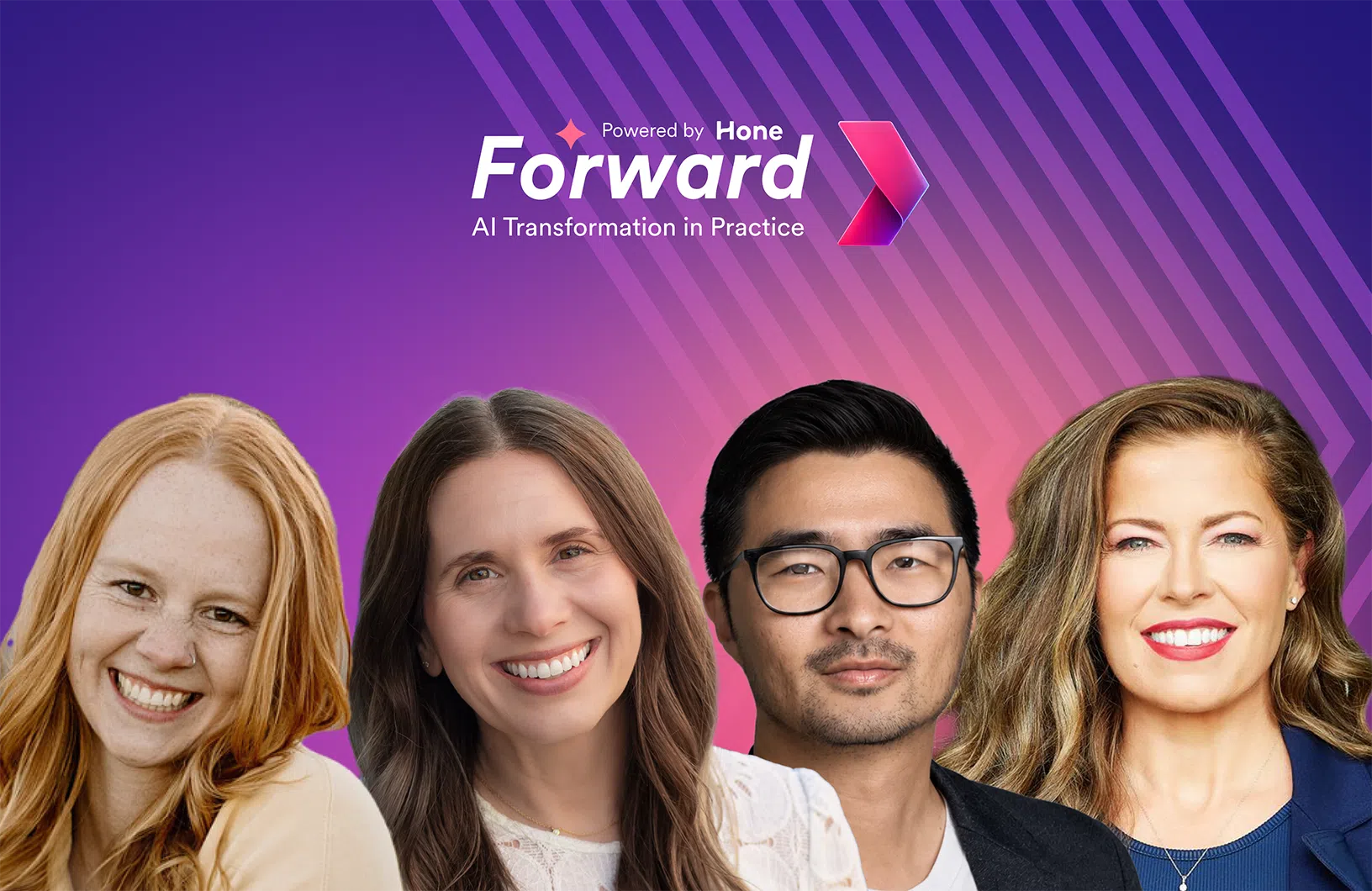
Below is a transcript from the recent session at Forward. Prefer to watch the recording? Click here.
Caelan Kaylegian; Senior Learning Strategist, Hone: Our next panel is one that I am very excited to be moderating. This is focused on building super managers for modern leadership. Leaders right now are being asked to do a lot, encourage responsible AI use, address growing employee concerns, improve workflows, help their teams adapt, all while building their own AI fluency at the same time. So we’re gonna talk a lot about what it takes to lead through all of this and how we can help develop managers who can do these things really well.
If you’ve been following along with us here today, you’ve heard my voice a lot. I’ll give a little bit of background on myself, then I want to turn it over to our amazing panelists here. I am a senior learning strategist here at Hone, and my background is in industrial organizational psychology. Would love to hear shout outs for other IOs in the chat if you’re there. There’s a growing number of us, so I’d love to see you pop off.
But my passion is really about learning and development and here at home I’ve spent a lot of my time helping folks to create transformative learning experiences and now a lot of that attention is focused on how do we help people become truly AI enabled in this day and age. Really excited to be joined by Jamie Will Fang, and Sarah Hagen as well, and I will let each of them introduce themselves before we dive in. Jamie, would you please kick us off?
Jamey Dubke; VP of People, AHSG: Of course. Hello guys. Good afternoon. I am Jamey Dubke. I have the privilege of leading HR at American Health Staffing Group.
And our purpose at AHSG is to increase access to high quality healthcare in the communities that we serve. And so when I think about building super managers, I’m thinking about leaders on our team whose decisions are eventually going to determine whether a clinician shows up for a shift and patients get care. And so getting our leaders fluent in AI is about giving them back time and wisdom to make good judgment calls. And our belief is that clarity, connection, and compassion aren’t skills that AI can replace.
They are actually going to be strategic differentiators in the workforce. And so if you think about this technology scale systems, but humanity humanity actually scales trust and trust is the currency for transformation for our super manager.
Caelan: And I’ll turn it over to Sarah.
Sarah Hagan; Head of People Operations & Strategy, Vanta: Speaking of of trust, my name is Sarah Hagan.
I work at Vanta, which is, a company that is trust and compliance based around security monitoring and compliance management with your auditors.
One of the things that I lead along with HR and people operations, I lead our corporate engineering team. So that is also kind of our internal technology on how we think about the systems that we have the… That employees are interacting with. And then, again, keeping that trust lens internally just as much as we are externally as well.
Caelan: Will, what about you?
Will Feng; Global Head, Learning & Leadership Development, Fabletics: Yeah. AI transformation is not just about technology. It’s leadership transformation. And I’m Will. I lead talent and AI enablement at Fabletics, an active leisure global company.
But I didn’t start my career in HR. I started in engineering. So I was an engineer and I took the leap of faith into psychology and human resources. Later, I got my degree in IO psychology, just like Caitlin and a lot of you here as well.
And then fast forward eighteen years later, I’m now living the best of both worlds, people, technology, AI enablement, creating the human systems to help people and organizations grow. And so buy me a matcha latte and I will share the stories in between. Know our time is limited today.
Caelan: I love that so much. Amazing. Yes, thank you all so much. Really great perspectives we’re going have on the panel today.
I do want to jump right in with our first question, which is all about let’s actually define what it means to be a super manager. So this is a new term to some people on the call. This is going to come directly from Josh Verson, who coined this term in his twenty twenty five report, People Management in the Age of AI, the Rise of the Supermanager, if that’s something that you’re interested in looking into. He has his own definition of supermanager, but I would like to talk to this group about what are those specific observable behaviors that come to mind when we think about what we need from a super manager in this day and age?
And Sarah, I’m going to start with you.
Sarah: Yeah.
So I believe a super manager is somebody who can ask the right questions for where the business is at and has the right amount of technical capability to be able to ask those.
I think one of the things that I’ve heard in all of the panels thus far is the term judgment. It has come up a thousand times in literally every panel and I think that judgment piece is part of that super manager. It’s the judgment of understanding what you should or shouldn’t build, what the guardrails are to build. And then if you don’t have the technical capability to build, being able to ask the people who do have this…
That technical capability what they’re doing and how they’re keeping that human judgment in the loop.
I think part of being a super manager is also creating space for people to be able to experiment in some places.
You know, I heard in an earlier call around the different archetypes of of how people are using AI. And I think being a a super manager is recognizing that those archetypes are different even within department and within team.
And how are you as a leader creating space but still asking the right questions so that that judgment is is put into place?
Caelan: Yeah. Absolutely. And and ironically, maybe not ironically, but some of those skills like judgment and creating those spaces are skills that we have asked for managers for for a really long time. Right? Like they’re evergreen, it’s just applied in a very different setting now. Right? So it’s how are we stretching those skill sets?
Sarah: Yeah, I think like one of the things I’m also seeing pretty heavily in leaders right now who are leading this AI transformation really well is the ability to set direction, pivot quickly And still tell the story about how that’s all the same thing.
It is the EQ to understand how to, you know, set that vision and bring people along, but it is the IQ to be able to recognize when something isn’t working and pivoting quickly that I think it sets really good super managers apart.
Caelan: Yeah. Super well rounded. I’m gonna come to Will next, but would love to hear in the chat. Obviously, you’re gonna hear from these amazing leaders, but if there are any other skills that are top of mind for you when you think about your own definition of what a super manager is, please put it in the chat. We’d love to see your contributions as well. Will, what are your thoughts?
Will: I like what Sarah talked about creating space. I think that’s become very important in the age of AI. It’s important before AI, but now even more important because it’s not just about I know the answer as a manager, right? It’s about how do we experiment different things?
How do we leverage AI here and also creating safe space for teams to come together to collaborate? And that’s key in leading AI effectively. And that’s where curiosity and moving from just convergent thinking to divergent thinking. How can I try these things differently?
We talked about design thinking before this AI thing, but it’s like, how do we think about this for experimentation? How do we try this? We might fail, but what do we learn from this quickly?
I think that’s happening day to day.
And if managers are not creating those space for their team members, they will not be able to kind of experiment, be curious and be able to try things out and report back to the teams and also share learnings as well. So it’s not just individual learning, like becoming an AI expert, but how do we learn AI together?
And that’s where I believe it’s so important for super managers nowadays.
How do we create a community to break down silos, to break down isolation and connect the people together, connect the team together. And even as an enterprise, how do we break down the silos across different departments? How do we learn with each other, learn from each other and share wins and really get better together? That’s where I believe the key skills and behavior, even mindset of staying curious and experiment different things.
Those are the key.
Caelan: Yeah, think that manager is a multiplier.
If we think about super managers, they need to have teams of super workers. Right? And so how are they cultivating that in their people as well?
Will: And super workers could also be agents, right, in the future. Even nowadays, it’s not just human agents. Now it’s like, how do we manage? How do we lead AI agents, so it’s very different nowadays.
Caelan: It is, yeah, you have this part human, part intelligent system, right, that you are being tasked to manage and what are some of those skills and so Jamey when I come to you, the next part of my question, if you want to add some color too is, you know, when we think about the traditional manager playbook, are there any skills that you feel are becoming obsolete at this point? And are there others kind of leadership fundamentals that you think remain timeless?
Jamey: Absolutely. And I just want to validate everything Sarah and Will said as well too. I think, what’s becoming obsolete is that leader as the sole, like, gatekeeper of all the information, like the the most wise people in the org. And I think we have to get away from that level one thinking that says value me as a leader because I know the most. We have to move kind of to those level three and higher level thinking to say value me because I know how to lead people who can do that.
And I think as we’ve talked and are starting to see, we’re getting away and using AI. I think we’ve gotten past the fact that it’s an intern and it’s a tool and it’s now a member of our team, right? Just like Will said. So now you have to think about, well, how do I manage that?
So where do our people have value? Where do they get energy energy from? And so if you even think about what’s happening in our engineering teams, we’ve had people who highly specialized front end developers, back end developers now turning into full staff generalists, and you’re starting to see that replicate across organizations.
I’m seeing that even in my own HR team when I’ve enabled them to be able to use AI and technology to do the things and automate all of the fragmented work that sucks a lot of their time, but steals their energy and joy.
And I give them the ability to do the higher level strategic thinking. We really start to elevate and we really create kind of those super generalists also across that. But I think as a leader what that also calls into question sometimes is my comfort and my value is it in what I know or my ability to lead and I think that’s the harder discussion I think a lot of leaders are having right now.
Caelan: Yeah absolutely, I think that’s all really incredible points and I’m seeing also some build off of this in the chat in terms of those leaders needing to be like true influencers in some of the ways that you’re sharing and also part of that influence I think goes back to what Clover, I see you in the chat as well, creating space for failure and encouraging those critical thinkers. So really great contributions again, would love to see if there’s anything else that anybody is thinking of in the chat.
I see Matthew, it’s an important skill for a super manager to still be a part of the team, find a way to get involved in some of the work that’s being done, and then be an AI champion and try to creatively bring it into the work so the team can see you leading in this new way of working. Absolutely, I think we all are on this journey together. I’ve heard other panelists say that today.
It is a journey, we’re all you know kind of leading each other through the experience. Jamie you said like we can’t look to the manager as the, because they’re more senior means that they know more necessarily about AI transformation. It doesn’t make them any less effective of a manager necessarily but they got to get on board along with everybody else.
The thing that came up for me in this part of the conversation I think connects the parts that all of you have shared, which is that this kind of traditional task of supervising people, right, which goes back to like I’m the leader of this and this hierarchy and I got to supervise your tasks and watch people work, now that supervisory has changed a little bit to be really focused on something that I think is arguably harder which is supervising a tool, right, that has the ability to hallucinate, make those judgment errors, and so I do truly think that like AI fluency for a manager being critical component of being a super manager, but that it’s not just being able to use a tool, it has everything to do with understanding the types of errors it can make, making sure that you understand how to coach team members on recognizing those things, which I think are still tools…
Skills that we ask of our managers every day. So I think supervision has just switched a little bit to include a broader team base than we had previously and I think it introduces some interesting management challenges.
Sarah: Caelan, I think one of the things that I have noticed personally, like in my own role, is my job is now giving more context. Because as a reminder, my team members can only create content or tools with the context that they have and what they have trained whatever agent or model on.
And yet that is probably still lacking a lot of business context that I have because of the visibility that I have with other meetings or one on ones or from my boss. And so I find that my kind of work has shifted to be more of a reviewer of a lot of that content that didn’t used to be. And so like my…
I still have the same amount of meetings. Right?
We’re still kind of doing the same amount of of work overall, but my my lens and review is needed. And that’s like the judgment piece, but it’s also, again, that context piece of how can I push my team to think differently because AI can create content after content after content?
But without that good context, it doesn’t mean anything, and it all kinda sounds the same. And really kind of pushing and coaching my team to kind of think more broadly there and not…
And shift from, like, the output focused to more of, like, what is the impact of this thing that we’re doing? And let’s make sure that it’s telling the story that we want, not just spitting out the details that we fed into AI.
Caelan: Yeah, and Dolores in the chat made a good point like the super manager still has to understand their profession and what their team does really well. I saw an interesting article talking about how kind of this generation of middle managers is going to be the last group to have done this task, some of these tasks manually, right? New workers are coming in and they are going to be doing these tasks only through automation, so they will not necessarily have that manual coding background, right, to then recognize, oh well I know why this code is broken because I’ve had to write this code myself, right. So there’s going to be gaps in some of this knowledge base that managers are going to be responsible for some upskilling as well in terms of how do we help people navigate this dynamic when they haven’t done the manual work that leads up to it, right?
Jamey: Caelan, I think what what’s really impactful about that is it’s changing the way that people are learning at a much faster pace too.
And so even if you take back if I go back a year when my finance team was coming to me and saying we need training and development on excel and now we couldn’t even imagine not using Claude to do the analysis and the modeling. And so now my finance team has moved from, okay, I don’t necessarily need training in Excel, but I do need to know the wisdom and knowledge to make sure that the data that it produces is real and it’s and it’s relevant and it’s true.
And so I think being able to model that also as a leader kind of changes the way we ingratiate AI and kind of help with the change management process too.
So if I, as a leader can start dialogues with, by saying, Hey guys, here’s the prompt I used. Here’s the content I gave it. Here’s what I fed it. Here’s what it did.
Well, here’s what I keep seeing. It’s a, it’s a repeating pattern, right? So everything’s in threes with AI, with the way they tell a story and the way it protects context. And I think, so it’s so imperative that we teach those skills, like what did it do well?
What didn’t do well, instead of like producing these beautiful, like communications and documents and PowerPoints now that I can’t even imagine six months ago it being able to produce, but now it can. And so now it becomes a better storyteller, but it’s, it’s strengthening our ability to be better storytellers too, as long as we’re able to apply the discernment to Sarah’s point.
Will: Yeah, I want to also add to like Jamey talked about, I have exact very similar example where like now even teams are using AI to create their own training. So they are not coming to HR or learning and development to say, hey, can you create this training for us? They are creating six week programs with AI. Of course, they still work with us as a sounding board in HR and learning and development. But they have this super tool with them now that they’re able to iterate. But the key point part is now how do they learn to use AI with the judgment, the curiosity and all of that so they can use AI effectively.
So it’s a mindset shift for us for focusing on just creating the outcomes, but why are we creating this and how can they leverage this tool to become super learners or super managers?
Caelan: And will what I love about that for HR, sorry, Caitlin was real quick, because this is finally the step that HR has always wanted. We have always wanted to be able to step into the advisory space instead of being the party planners and the police and the administrator. And so now you get to truly see HR’s value and how it does drive EBITDA. I think this is like the most opportune time to be in the people profession.
Will: Yeah. And that’s why, like a lot of organization that’s well said, like when we’re thinking about just how can we leverage being more strategic, that’s an exciting opportunity, exciting time for HR learning development, people focusing on AI transformation is focusing on enabling the people, not just do the work for them, but enable them to do, right, to lead AI effectively, to do and build with AI.
Sarah: With the right boundaries. So I think one of the things that I constantly try to remind is like Jamie, I love the idea of here’s Excel, here’s what I put in the prompt to fix this formula. And and here is why I didn’t take this finance worksheet or this, like, you know, list of employee data and then feed it into AI to then post on the web. Right? Which, like, I think requires that judgment piece that managers need to constantly share and continue to trickle down, which is not necessarily a new skill, but it is the first time that I think, maybe not first time, but it is it is on a large scale we’re seeing leaders need to be really explicit about not doing something when it used to be are you doing something.
Jamey: Yeah and Sarah I think also too kind of that what’s off limits list is where like if you think about the role of leadership, it’s to create the environment that enables people to fail fast and safely. And so if you create the guardrails and the safety, it makes people feel more comfortable to even try things and be brave. When you tell them, hey, don’t use, SPI and all this personal data, like you would assume that that’s, you know, a given, but you don’t want to assume also. And I think what’s interesting and without naming names and getting into the safety debate, I think what we’re starting to see even in the AI research world right now is that the people who are building the technology will tell you they don’t even have all the answers yet.
They don’t even know what’s happening. And we keep finding these models that you know, get shut down on a weekend because somehow they shut down somebody’s government or somebody’s security system or went into and erased somebody’s bank account. I think I think all of that plays a role in this and so the discernment and judgment for sure is, is going to have to be over indexed in this next season.
Caelan: And I do think that is going to actually segue us nicely into our next question. I think we could all talk about this, this one question for a long period of time but I like where this takes us which is that everything that we talked about like we’re asking a lot of managers on leveraging skills they should already have in new ways. Maybe some of our managers who are frontline and new don’t have those skills yet haven’t even had to apply them normally, Right? We’ve people who aren’t motivated to use those skills potentially, and they’re being asked to do a whole lot.
So are we at risk of asking managers to do too much? Are we asking too much of them? And with this new definition of what it takes to be an effective manager, what organizational support, do these managers need? And Will, I’d really like to start with you for this question.
Will: Sure. So I will say this isn’t about adding more to the plate for managers. It’s about using AI to finally focusing on what matters most. And that’s a very important paradigm shift.
Meaning like when we’re asking managers not just like, okay, go try out the different tools or right. And just do everything with AI. It’s about, we talked about the discernment, the judgment piece. So like first part before that discernment is what are the key priorities I need to focus on now?
What are the key right? Big rocks, right. That I should focus on. And then in the age of AI, these are the three things I need to focus on.
And these are the three things that’s going to help the business, whether it’s generate more revenue or member conversion or reduce cost per acquisition. What are those key business outcomes? And then that’s where managers really take that and say, okay, how can I really focusing on using leveraging AI, whether it’s the tools, whether it’s redesign the processes to support the business? And that’s one learnings for me is in the beginning of AI more than eighteen months ago is people just getting so excited about AI and managers getting excited.
They’re like, let me try this, let me try this. And a lot of shadow IT happening without the guardrails. And then now people get to a point where, okay, I’m a little bit more proficient with AI, but now there are people are just individually trying things to be more efficient, to be faster. But I think the other thing is we should be slower in the age of AI is how do we slow down and say, what are the key most important things I should focus on this week or this quarter, this month?
And then focusing on just those three things or two things, and then leveraging AI to say, how can AI help me here? And even think about, does AI need to be here for this process? Or maybe we don’t. We don’t need to use the AI for everything.
So that’s where, as we’re asking enabling managers, it’s not just about using AI for everything, using AI to be more efficient. Now you have fifty percent of the time that that saved, but then you have more things, right? Just tedious things you need to add, tactical things.
I think it’s really a different approach is really slow down and say, what do I need to focus on now? And then how can I use AI to leverage them? Not just for another task, but a way to be more creative, be more innovative and to get to the better results faster as well.
And that’s where, as we’re asking managers, enabling managers, we are creating the conditions to protect them, the resources, the tools, of course, the training and all of that. But then they are also be able to have space to say, okay, how can I be more strategic now leveraging the AI tools?
How can I, know, we just talk about this, right? Like moving from the transactional HR learning and development work to be more strategic partner with our leaders. So it’s really a shift of our roles and as well as we increase and upscale our, you know, in terms of AI and leadership skills.
Caelan: Oh, see Sarah ready.
She’s ready to go.
Sarah: Plus one on all of that.
I think one of the things that… I actually do think we’re asking our leaders to do a lot and at least because the pace of AI is changing the way that people work, particularly at companies. So I work at a technology company, there’s fifteen hundred employees. And so we are AI native, People are using it in their everyday work, right? There’s no like formal sit down and learn this skill thing that was eighteen months ago as Will mentioned. So part of it is from an enablement standpoint is actually just making sure that what we are asking them to do from an HR standpoint, so for example, performance reviews have skills or like MCPs that connect to the tools that we use so that they can stay in where they work, right, and still do the thing that we’re asking them to do.
So we still think it’s an important part of employee life cycle to check-in with your manager on how your performance is doing and share that quarterly conversation or that feedback or one on one topics. And to do it, we wanna make sure that we have all of the tools connected and the tools that you’re already using so that it doesn’t feel like this big lift once a quarter or once a half or once a year whenever talent reviews come up, but that it is within your work stream. And I think again, that is putting a lot on our managers right now because now you’re reviewing all of that content. AI is pulling it all together. It doesn’t mean that that work didn’t happen but it does mean now you have to spend a lot of time focused on what that thing is. So I saw that Clover asked, at one point should orgs begin training super managers so that they can champion this change and empower their teams to use AI? And like I think I would pause it that it’s actually not using AI that’s the problem for us anyway.
It’s really making sure that people are using it in the right ways and also again using that good judgment of when it shouldn’t be used, what the guardrails are, making sure that we’re not launching crap, and and, right, providing that feedback piece, which is…
Are all pieces of, you know, management that have been pieces of management for quite a while, you know, post command and control, but but how you can do that with a with a piece of technology that basically enables people to do, you know, eight times the work that they used to do.
How do you then manage those expectations?
Caelan: Yeah, you bring up a couple interesting points. So one I think is we’ve come back to like the amount of work it takes to check AI work, right? And there’s actually a term that I’ve just started to hear getting thrown around, which is like this verification burden, right, and it’s this new task that we have to take on which is this cognitive cost of constantly having to check AI outputs for correctness before it goes out the door, right, and I think there’s some arguments there about like if the amount of time you’re spending having to evaluate an AI output, should we even be giving those things to AI, right?
You know there’s a return cost there, but I think it’s an interesting new part of a manager role that I do think is wearing down managers engagement and we have to really think about you know the second half of my question which was you know what are the supports that we’re providing? If we are increasing demands, are we increasing those supports in a meaningful way at the same time or are we just saying like AI is in your hands, thank you so much, for supporting our strategic initiatives, good luck to you out there, right?
Jamey: Well and Caitlin, I think that’s the brunt of the work right now too even for all of us who are trying to create these AI fluency academies and strategies and what is how do you define mastery in that space because I also agree with Sarah I think the burden that that the middle management layer all of this falls on because they’re the ones who have to bear the burden of most of the change management effort as well. We are not an AI necessarily native company now. We’ve been dabbling in tools for a long time, but we have pockets of that. Some of our work has not yet integrated into AI.
So the adoption of that, I think, Sarah, to your point, even trying to get leaders to operate at the top of their license and their performance review cycle, we just actually had a leader lunch and learn today, and we were giving leaders prompts like, hey, here’s a way to prompt it to make your life easy. That’s still like takes a lot of change management to get people comfortable because also, again, you have leaders who are are trying to also get rid of the scarcity mindset and the fear of using that tool. And there’s, there’s differences even in the generations, people are hesitant to use it because they don’t want to outwork themselves.
And I mean, a few weeks ago you heard on the news, like the, the, somebody from somewhere was talking about how, well, we’re training our replacements with AI, or there was something on LinkedIn where a video was like, oh yeah. And here’s how, what we need you to do for the next six weeks. And then six weeks later, there’s a rift. So that mentality is very real.
It resonates with humans today.
So I think we are on the battlefield as leaders is trying to figure out how do you help people see the value in learning that space. And I think it’s upon the organizations themselves to set that clarity.
I know for us at AHSG we have come out and said look our job is not to replace a ton of people, our job is to upskill and we want to make the investments in the people who are here so that we can continue to 10x growth instead of looking at it as a reduction.
Because I also find it humorous too that everyone’s like, oh yeah, you know, I just, I replaced my HR team or I just got rid of them all and all my problems went away. You’re like, that’s not how this works friend in six months when the EEOC comes to your office, you’re gonna have problems. So I think there is a big burden on our leaders. And I think it just, if we can get them in the right space with the right training, while also giving them the time to do that, I think that’s probably the biggest ask right now is giving them dedicated time and the space to be able to play with the tool.
Will: I want to add something to what Jamie, and Sarah just remind me of that setting expectation and clarity. And that’s what I learned in the past year is the leaders are like, what should we do next beyond the tools in training? It’s setting that expectation. What does a good manager look like or a super manager look like?
What are the things they need to do? So we have been on this change management in the past few months at Athletics, setting that expectation. What are the key behaviors that managers should focus on to help enable their teams? And before they will do everything.
And that’s why they feel the burden of like, or burnout, there’s just too much to do. But now we’re setting that clarity. Here are the things we’re expecting as an organization. And of course, collaborating with the managers and leaders to drive change so that they feel like, okay, here’s what good look like.
Here are the things, here are the gaps. How can I focus in on these behaviors as a leader and to enable to create the conditions for their teams to build and learn with AI?
Caelan: Y’all are teeing me up so good here. So Will, we’re going to use what you just talked about in terms of how are we developing those skills and going into this next question. But how do we all think that leadership development has to evolve for a role that is changing this quickly and that does have so many demands on their time already?
What should really replace maybe the traditional workshop heavy approach that has worked or has been kind of relied on in this space for so long? Jamey, I’d love to start with you on this one.
Jamey: Yeah. I I mean, I think it’s it’s it’s as easy as bringing it into team huddles weekly, where you could even take, the first five or ten minutes of a meeting and say, hey, everybody, I want you to share one prompt that worked well, what didn’t work well, kind of sharing content. So I have it set up so Claude actually creates kind of a, a morning kind of brew for me. It it goes and scrapes all the data about AI, about everything in HR, and then being able to facilitate that dialogue and content and asking my teams to use AI to pull from it what they need.
And so I I think it’s just showing them real life examples because again, if you think about the, the human capacity for learning, it’s the learn see do model. And yet our time domains right now to be able to have attention span is so short. So it’s like, how can I use AI to actually make this stuff digestible and easy to use? But then how do you practice practice that daily with your teams?
Caelan: Yeah. Amazing. Sarah.
Sarah: I wanna use a great example of what Jamey just said. So I feel actually, like, very proficient in AI, and I have plenty of my own agents doing things. And yet, it did not occur to me to do a morning brew of the HR news. And, Jamie, there’s been, like, three different times in our conversation before this and also this recording that you have mentioned news articles. And I was, like, over here thinking, like, wow. She’s up on news.
And you’re up on news because you’re using AI to pull some of that and so that you can, like, see it coming.
And it’s just… I use that as an example because, like, I think part of what I try to to do that Jamie mentioned quite well is that that share piece of it’s very easy to share when you feel like you’re building something very, very large, and it’s going through a whole bunch of different people and it’s a big workflow that’s doing all of these things. But sometimes the smaller pieces of like, oh, this is helping me be a better leader or a better manager or get more business context or look at the news around HR or Anthropic or whatever. Right?
I think there’s a piece there that somehow gets missed when you don’t create the space and time to even just talk about it casually with peers or with your team. And I think that’s a piece that, gets missed very easily because people auto go to task.
They go to here’s the thing that we’re working on or here’s the big problem that we’re gonna talk about and not just like, let’s chat a little bit about, like, how we’re working.
Jamey: Sarah, also, I’ll have to share the prompts I have because I’m a working mom. And so I also have Claude. That’s also my personal chief of staff with my kids calendars and schedules. And I had to learn that from another mom also too, because you’re just so inundated with all of the things.
Will: I needed to.
I will say like the struggle for like HR learning development around this leadership development is feedback and reinforcement.
And like, okay, we have the big event, we have workshop, we have trainings, but what happened after that? And that has been a struggle for learning and development teams and HR as well as how do we reinforce? How do we apply that? My own personal story is that after attending workshop, as a leader, as a manager, where I sometimes will talk to my AI assistant or practice with role play with my AI.
Even when I drive, my car has an AI assistant in there. So I talk to my AI like, okay, I’m practicing this difficult conversation with Tesla. So there’s Grock in there. So practicing different using different AI coaches assistant in between the events is what’s the key impact for me with AI and leadership development is in between those moments.
And then in those moments, whether it’s talking to a human coach or maybe it’s an AI coach, and then practicing role play those difficult conversation, a feedback conversation as a manager, practicing that. And I think that’s where I found so important in really development moving from just the event to reinforcement in the environment that we create for our people. And that’s in between the liminal moments and that’s the key, creating that design. And HR, L and D should own that part, but we should create the condition and not like, hey, you should do this, you should do this, but using AI to design, architect that environment, that journey for leaders so they can continue to learn, continue to apply, continue to learn from each other.
And that’s where I also want to mention, I’m a client of Home, so Home is doing fantastic there with AI coaches and the practice as well.
Caelan: Yeah, thank you Will. Yeah, I think that goes back to just principles we know and love in this space about training. Training, right? Like we know that spaced learning is always going to be better than just mass learning any day of the week, it doesn’t matter what skill we’re learning, whether that’s the judgment or how to give a good prompt to an AI tool, right? So how are we really leaning into the new tools that we have to create opportunities for that?
We are getting down to the wire here. I do want to leave with a statistic that I think just again gives us all faith in like the work that we’re doing here. I think we all know that leadership development and training in this space is really, really important. And I think even more so now in the age of AI.
So if anybody needs any fuel to kind of support the reasons for more training and development in this space, McKinsey’s newest guidance is that successful AI transformation follow the one three five pattern. So for every dollar invested in agentic technology, dollars three should be spent on process redesign and five dollars should be spent on capability building and adoption.
So if there is not a stronger argument for why this work is so important, why investing in managers is so important, I think that model is really effective there. So I wanna thank you all so much, the three of you, for being a part of this panel. I feel like we could have talked for double the amount of time. I only got to peek behind the fourth wall and got to a fraction of the questions that we have for everybody who’s here, but loved being a part of this conversation. Thank you so much to the three of you for sharing such great insights and anecdotes. I can’t believe our time’s already up.
Jamey: Thank you so much Caitlin too for facilitating this, this is cool.
Will: Thank you.
Sarah: Thank you.
Caelan: Thank you. And then coming up next, please pop into our next session. Josh Zimmerman from Kong is going to share how his team built an AI powered system based on employee engagement data that helped close skill gaps and assist managers in building new capabilities right in the flow of work. So it’s a great continuation of this conversation. We’ll see you over there.
Thanks everybody.


