












Below is a transcript from the recent session at Forward. Prefer to watch the recording? Click here.
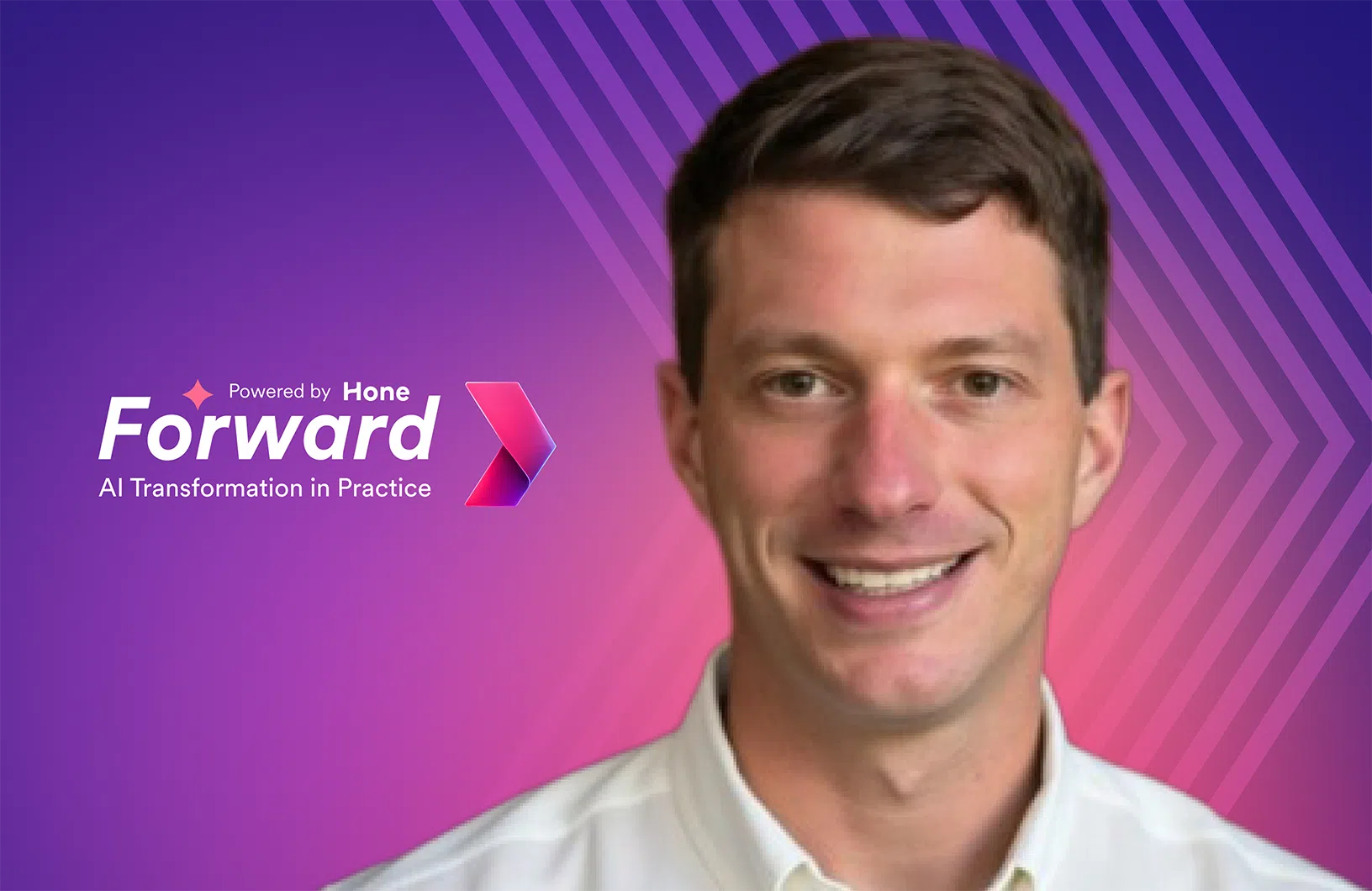
Rea Rotholz; VP, Solutions, Hone: We’re here for our next keynote, A Framework for Developing Managers in the AI Era. I am welcoming Josh Zimmerman, Senior Director of Talent Development at Kong Inc, who spent more than fifteen years helping high growth tech companies translate business strategy into real organizational capability. We know that’s not easy through leadership systems, performance frameworks, talent strategy, and more. Today’s session walks through how his team identified an opportunity to use AI for manager development, building a workflow that connects employee survey data with habit building microlearning to close skill gaps directly in the flow of work. We’re so excited to have another real life use case of how this comes to life. So with that, Josh, I will kick it over to you. Thank you so much.
Josh Zimmerman; Global Talent Development Leader, Kong: Awesome. Well, thank you so much for having me here.
I am, honored by Hone, you know, super excited to talk to you all about developing managers in the AI era. So I’m Josh. I lead talent development at Kong, and I’m sure, like most of you on this call, you’re probably wondering, how are we gonna train and develop leaders in this new world of work that we’re living in in the AI era? And today, wanna talk to you about, you know, a new program that we’ve launched at our organization and give you all some food for thought for creating something similar within your company.
So let’s get into it. Alright. So before I get started, I’d love to know how much has manager development at your org changed because of AI. So you’ll see a quick little poll there.
Have you seen complete redesigns, significant update, new AI related additions, changes are planned, no changes yet.
Okay, so interesting. I think a lot of people are kind of right there in the middle with a few AI related additions, changes are planned. And I think that’s really the world we’re living in now.
Things are happening, but we don’t really know the traditional classroom model, whether that’s virtual or instructor led training, still works when it comes to developing and equipping our leaders. But how do we use AI in this new world we’re stepping into?
So I wanna talk a little bit about Kong and where we are and who we are and how our manager population has grown over the years. Years. So if you’re not familiar, Kong is the AI connectivity company. If you think of a control tower at an airport, you know, they are directing and managing traffic. They’re they’re, talking to planes as they’re coming in and as they’re taking off. Kong does that for your AI infrastructure and your AI architecture. So we are connecting AI between different applications.
And so we’ve seen massive growth within the organization. We are globally distributed all over the globe. We have employees in different time zones and different geographies. And over the last year alone, we’ve had a thirty five percent increase in our manager population.
And on average, managers have around six or so direct reports. Now those direct reports can be virtual, they can be hybrid, they can be in the office. And most likely, some of those direct reports are in various different time zones and in geographies. So it’s a tough job. You know, managers work really hard. And from a talent development perspective, we are supporting the whole globe with a pretty small and nimble and agile team of two. So small team supporting rapid growth in our leadership across Gong.
And, you know, I’m sure you all have heard the quote before, you know, people don’t leave organizations, they leave their manager. And I think that’s true for most companies that you probably all worked at. I know it’s true for myself as well. And you will see lower turnover when managers actually receive development.
But we know that taking managers out of the front lines, out of the trenches to actually take training is pretty difficult. So what we wanted to do is build new systems using AI where they could actually learn in the flow of work. So I’m gonna show you how we did that.
And, you know, I think every organization, right, we have a lot of rich signals when it comes to manager effectiveness. There’s a lot of sources of data out there to really understand how our managers are doing, where those development gaps are, but what can you actually do with that data? And there’s three sixty, there’s skip level, exit interviews. The sky’s the limit.
There’s so much out there in terms of data. Some of it’s anonymous, some of it’s not. It’s understanding how the manager is doing and using that to build development. But there’s so many sources of data, how can you connect those sources of data to build effective development?
And for Kong, for this UK case in particular, we wanted to focus on the engagement and pulse surveys, because there’s a pretty big gap between measuring engagement and then actually doing something about it when it comes to action planning. And I’m sure we’re not alone in that struggle, and most organizations are. So we wanted to create a system to close the gap between the engagement survey and the action plan. And I’m going to show you how we did that.
So if you are familiar with engagement surveys, they typically measure ten or more different drivers around what it takes or how employees are engaged within an organization, whether that’s career growth, manager support, goal setting, so on and so forth.
Most engagement survey tools have, like, a standard, you know, drivers and prepopulated questions. They’re pretty universal across the board.
The feedback is anonymous, so employees will give feedback on their manager as well as the organization as a whole. And then the manager will get a dashboard view of, okay, this is how I rated in the last engagement survey. In this case, if I’m Alex, I see my manager dashboard, I say, great.
I’m doing really well in all of these different drivers. I’m gonna move on with my day and that’ll be it.
But what if I score low in one driver, let’s say in this example, let’s use Rekognition.
I see my manager dashboard, I see feedback from my direct reports, qualitative and quantitative, totally anonymous that says, hey, maybe I need to do some things to improve my ability to do Rekognition.
Maybe that’s having more public recognition or using the Cheers and Celebrate channel or putting up somebody for awards or just acknowledging somebody’s great work.
So you as a leader, you see this score, you see low recognition, and you ask yourself, what am I gonna do about this? How am I actually gonna close this gap? I’ve got so much going on. I don’t have time to come out of training or do a course or do a training.
And that’s why we developed the Silverback Coach. So managers are super busy at Kong. We do have a lot of formal learning, but learning the flow of work to promote behavior change is something we’re really experimenting with, with AI and the use of it to really drive those changes end to end. So what is a Silverback Coach?
It is a Slack bot. There’s custom curriculum and a workflow. You don’t have to use Claude. You can use whatever AI tool that you have to build these automizations.
And then, you know, it’s really tailored to Kong’s leadership philosophy, and then it provides that behavior change. So in typical, you know, Kong fashion, we had to really brand this with our gorilla. We love the gorilla within the organization. So it is the Silverback Coach. And I’m gonna show you how it works in practice.
But before I do that, I wanna talk about the manager development loop with the Silverback Coach and how we’re connecting that with engagement survey to close the gap on specific development needs. Alright. So for one, we’re listening. Right? We’re using that organizational signal of engagement survey data to really pinpoint specific development needs, identifying the gaps. And the example I showed earlier, it was recognition for Alex, the leader. So Alex, the leader, is going to focus on recognition in this example.
And then nudge, right? It’s creating that cue. Is it every day sort of micro learning? Is it once a week? Is it once a month? It’s really understanding what is the nudge? How often do we need to reinforce this behavior and to build these new habits?
And then it’s practice, right? Doing the curriculum, like I mentioned earlier, building those new habits through short micro training sessions, reflecting, noticing the impact over a period of time, whether that’s a few weeks or a few months, and then measuring that and improving and moving forward. And this is a loop, right? So you can start the nudging and the practicing, and then in three months, can remeasure something around recognition or another engagement driver or all of them and see where that gap has closed. So I’m gonna show you what that looks like in practice when it comes to recognition.
All right, so like I said earlier, it’s listening and diagnosing. In Alex’s case, she sees, oh man, recognition, I scored low, what am I gonna do about this?
And you can start diagnosing, you can dig into that data specifically for recognition. Recognition might look different to every employee on her team. So maybe some folks want to receive public praise or praise in private, or just want a simple shout out in the public recognition channel, whatever it is, we can really diagnose those themes and create personalized curriculum based off of individual needs using AI.
All right, so nudging, right? So once you’re enrolled in the Silverback Coach, you’ll get a message every six weeks or so, or no, over the course of six weeks. Each Monday, you’ll receive a prompt to do an action during that week, and then on Friday, you’ll do a reflection. So in this case, because Alex scored low in recognition, it was, you know, send one specific name recognition to a team member before Friday. No later, no skipping.
And Alex actually does that in our public company recognition channel.
Your company might have a similar recognition channel at your organization, and Alex gave Taylor public recognition. And in this example, this is what made sense in terms of a recommendation for a learning for Alex to do.
And then it’s a reflection. So on Friday, they’ll receive a message like, how did it go?
You know, how did you feel like your ability to provide recognition? Did you close that gap? What habits are you building to improve that? And there’s not a way to, you know, correspond with the Silverback Coach right now. It’s more of just a way to prompt messages and send people information.
But hopefully in the future, for future iterations, you’ll be able to correspond with it.
And then it’s measuring that. So three months down the road, it’s measuring doing another pulse survey with their team, and then seeing if there’s a change in that recognition score over time. And in this case, there’s a ten point increase.
Great, she’s at benchmark, she applied some of the learnings that we gave her during the micro learning sessions through the Slack curriculum, and there’s been a correction in that one specific development area. Great to see.
And then measuring it, also providing feedback on the SilverBack Coach so that we can make iterations and update as we go, getting them to provide us feedback. So that’s really the development loop in practice applied to the recognition driver. I will say that you can apply this use case to different engagement drivers, whether it’s goal setting or career growth or manager support or whatever the case may be.
But we know that managers, you know, there’s a place for formal learning and there’s also a place for building habits, and you build habits by learning in the flow of work.
Alright, so what are we learning and what’s next? So we’re pretty new at this. We’ve piloted it with twenty five managers in the organization. It’s ongoing right now. We’re going to roll it out to the rest of the organization to promote some behavior change for our performance management cycle coming up in February, March timeframe. But I will say some really key learnings as a result of this is specific behaviors outperform broad leadership themes, right? You can do a one size fits all approach around recognition or another sort of theme, but something that’s really personalized to the individual needs will actually go a lot further.
And then reinforcing the manager’s existing workflow. If you’re at a hyper growth company or really any company, there’s a big load on leaders and taking them out of training to do formal virtual or instructor led training, it takes time, it takes resources. So applying a practice in the flow of work is a great method. And then AI needs organizational context, right?
So if you have core values and leadership principles or a leadership philosophy, if you are a distributed organization, if you have a how we work operating manual, whatever the case may be, providing that organizational context to AI so they get to know the organization, and they can really tailor that leadership curriculum based off the org, the better. But I will say, lastly, you’ll get a chuckle out of this. I don’t know why AI makes me look like a sixteen year old, but keeping that human in the loop. I think we’ve especially at Kong, and I’m sure you’ve seen it as well, you see messages and you can clearly see that they’re written with AI.
And we wanted to really threaten personalization and human touch because I’m not sure if there’s been any studies around this, but you can I think people are more receptive to messages if they are more personalized and human? So putting that human in the middle of the loop and making them part of the process.
So you’re probably asking yourself, what can you do? What can I actually do to build this out within my own organization? And I will say I’m a limited technical person. We did have some support from IT and engineering, but you can do this if you have access to basic AI tools. The sky is the limit, really.
So first thing you wanna do is choose that meaningful data source of manager data, whether that’s your engagement surveys, scores, 360s.
I would definitely on the side of anonymity, of course, but picking a data source that measures as an input to manage your effectiveness.
And then diagnosing, right? What’s the specific behavior behind the data? What should managers really do differently? Maybe your company is rolling out a new leadership philosophy and your CEO wants every leader to understand that philosophy, well, those are the behaviors that you want to thread within the Silverback Coach or another workflow that you decide.
It’s really up to you to figure out what are the behaviors you want the leader to do differently. And the engagement survey made it pretty easy because it was identified. We picked the lowest driver for every manager in the pilot. And then nudging, right? This is where you’ll probably need some AI or IT or engineering support, unless you’re like an engineering wizard.
But it’s relatively easy and it’s to deliver that timely personalized cue. Is it every week? Is it every month? Is it every day?
It’s really up to you to define that cadence.
And then practicing. This is where the fun part is, where you can build out that curriculum, you can build the micro learnings, the prompts, the conversations. Maybe there’s a link to your LMS or your learning platform to reinforce a specific learning or training or a video from your CEO, whatever the case may be, that’s how you can practice and reinforce that behavior. And then reflection, right? Making sure people look within so that they can grow and what should change and how they can do things differently. And then lastly, measuring that over a course of time.
So that’s, it sounds easy in a nutshell, and it does take work, but it’s relatively straightforward. And, you know, I think a couple of years ago, this wouldn’t have been possible, but now it is. Being able to connect something like the engagement survey data with action planning in the flow of work, that never really existed before. But now you can actually do that yourself if you have access to and the right resources.
And I will say, yep, there’s a little line there. Lastly, I just wanna leave you with this. I think if you are a talent development professional and been an L and D for a long time, there’s still a need for leadership development. At the end of the day, the manager has to deliver the message, whether that’s the career conversation, the performance feedback, the career development, the coaching, the performance, you know, all of these things take skill, and it’s not gonna go away.
Unless, you know, we’re all ruled by robots, but that’s not going to happen anytime soon. Managers are still going to lead teams. The teams are probably going to be bigger. So those conversations are going to be even stickier, and they’re going to be more important.
So I think if you can combine the use of AI and the flow of work with traditional manager development practices, like those virtual instructor led training and ILTs and self paced training, I will say at Kong, we’re launching a six module series around leadership conversations, and then threading that with AI to practice those reps and measure and improve as we go.
So that’s pretty much it from me. I just wanna thank Hone and everyone listening. Shout out to Samantha on the talent development team who’s been rocking it. It’s kind of my idea in my head and she helped, she really executed and brought it to life. So hit me up on LinkedIn, check out Kong.
I think the more we can build, the more we can do.
Rea: Amazing. Thank you so much, Josh. Interesting to see real life what you’ve created for such an interesting purpose.
We did have a couple questions if you’re willing to answer.
Josh: Yeah, let’s do it.
Rea: So someone wanted to know just in general, how long did it take to build this out?
Josh: Oh, good question. It took about, I would say end to end, it was probably about six to seven weeks, you know, given, like, other priorities and just building. But, you know, I think the the the hardest part was just building out the curriculum, itself and really tailoring that. But once you have that in place, it’s, like, there. You can apply it for scale as you grow. It’s just that initial building phase takes a while.
Yeah. The the learning curve. Learning curve for sure. Jen was curious what your cadence of engagement surveys are.
How often you do Oh, good question. I wonder if that’s Jen Ryan from Yeah.
Rea: Jen Ryan.
Josh: Yeah. Yeah. I might know her.
Engagement surveys is we do one we do two a year, and then we do poll surveys that are more like team and individual leadership, manager focused, and those are a little bit more ad hoc as we go. So two engagement surveys a year.
Rea: Perfect.
And then Dustin, what’s up, Dustin? What sort of accountability mechanisms beyond the public recognition example exist to confirm whether managers are actually following through on their weekly prompts?
Josh: That’s a great question. So I, I would say for the recognition example, we we actually measured that, and we saw fifty four percent of the leaders that had recognition as a driver to to improve, fifty four percent of them actually gave public recognition during the pilot phase of the Silverback Coach. So that’s like one example. There it’s a we’re still figuring that out. It’s a little bit manual, But I would say the biggest accountability piece is remeasuring that after three months or so they’re enrolled and seeing if those scores have increased.
Rea: Makes sense.
Yeah.
Okay. We can make this the final question. This came in the Q and A, and I think it’s a good one because often we’re thinking about the build versus buy question. So the question was, this probably exists in other survey platforms, like engagement survey providers, I assume, but what was the impetus to build this yourself? What was some of the reasoning or how did you think through that?
Josh: Yeah. I think it’s a great question. And it actually is pretty limited in terms of an off the shelf thing that you could buy. That’s this integrated with engagement surveys and action planning and learning the flow of work.
I would say our impetus was, you know, we do these engagement surveys, we drive org level behavior change and maybe functional behavior change, but then doing that at the leader level and the individual leader level is really difficult. It’s really up to the leader to drive that. And I will say, like, a lot of leaders just don’t have time or they just it’s not a priority. So that was really the impetus to to do that.
And I think Kong is an awesome environment because it’s allowed us to really experiment with AI. We’re pretty AI centric in the middle of it.
So yeah, we just wanted to build.
Rea: Yeah. And then it can be completely bespoke to you and you know like you said maybe the perfect fit wasn’t there in the market.
Josh: Yeah and I definitely think there’s a lot out there in the market and I know there’s gonna be more and more.
Rea: Well thank you Josh so much for joining us today and sharing this presentation. We are excited to hop over to our final session, building a network of AI champions to drive change from the ground up. I will see you over there. Thank you all and thank you, Josh.


