












Below is a transcript from the recent session at Forward. Prefer to watch the recording? Click here.
Caelan Kaylegian; Senior Learning Strategist, Hone: Credit for the DJing here. This is all Zach. So thank you all so much for joining this amazing session. I have the honor of introducing Zach who I have the privilege of working alongside and collaborating here at HONE.
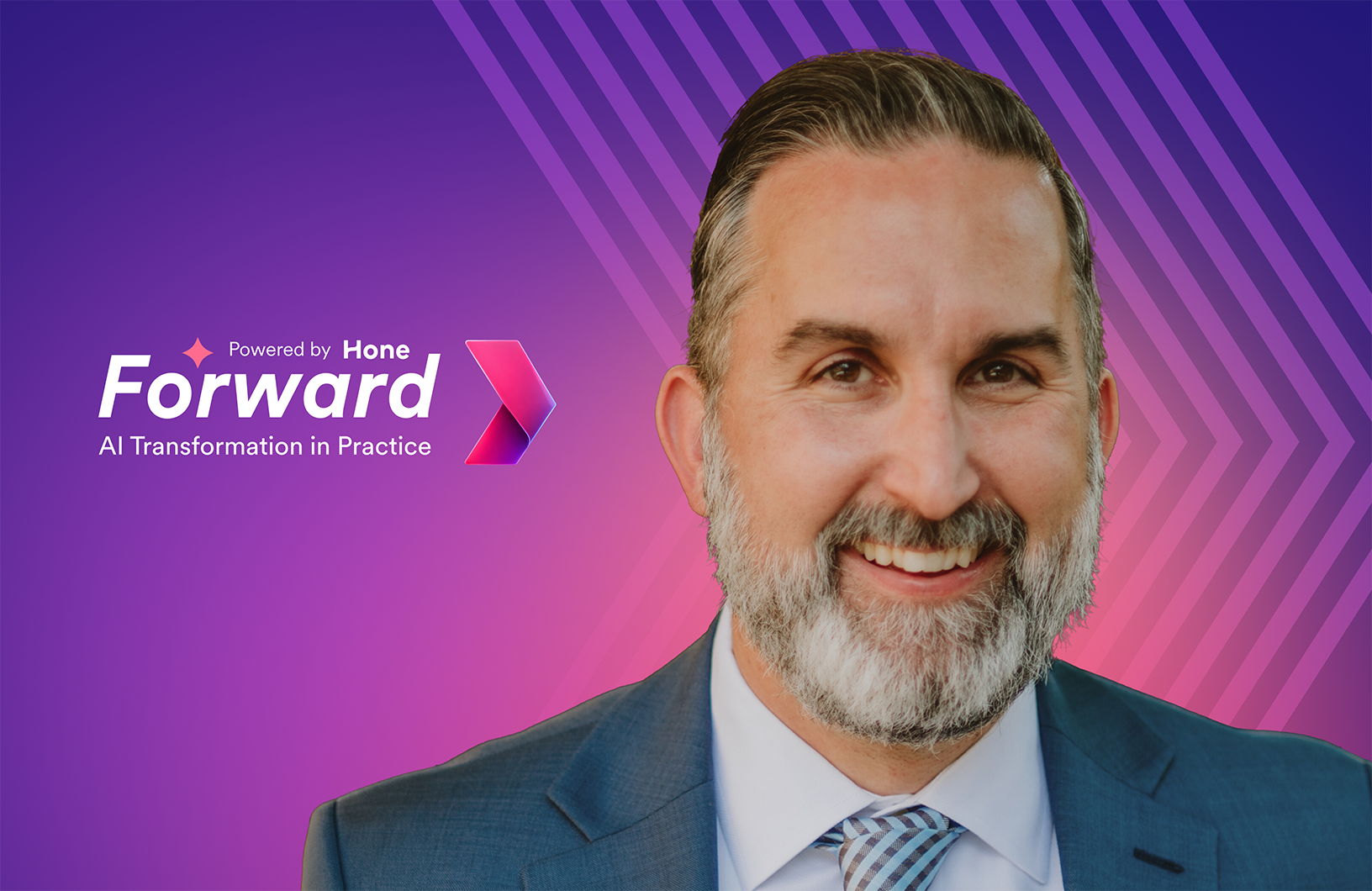
So really excited to introduce you to him. He’s the Senior Director of Learning and Leadership Development at ModMed. There he’s leading global talent capability, enterprise learning, and AI enablement across both the US and India.
His session today is going to take us inside a full year of building AI fluency at ModMed, what worked, what he and team learned, and how they turned really early champions and use cases into lasting adoption across the organization. So Zach, you started us off so strongly. I’m excited to see the rest of your presentation. Please take it away.
Zach Ward; Senior Director of Learning & Leadership Development, ModMed: Awesome. Thanks, Caelan and thanks, Hone and thanks to everyone who is behind the scenes at Forward.
It’s been awesome to listen to the panels and all the conversations so far. So we only have a limited amount of time, so we’re gonna rock and roll. About a year ago at ModMed, we’re presented a question that’s faced by every organization here at Forward. Do we wait twelve months for a perfect corporate AI strategy, or do we start building an AI first culture right now through active and enthusiastic experimentation? So our learning team chose to build in motion. We didn’t get specific direction.
We just started building. So today, I’ll share how we’ve built a foundation and encouraged enterprise wide AI fluency without a formal road map, how we shifted employee mindsets, and how learning out loud, which is a core philosophy of my own, how learning out loud became our secret weapon for adoption across the business. So thank you, Nano Banana, for the alternate headshot here. Sadly, I don’t have an actual robot mask, but I do feel like the last year transformation has been by Daft Punk era.
By the end of the conversation today, we’ll review four commitments we can all make, and fingers crossed, we’ll have a few minutes for Q and A. So first, would love to see where everyone is today.
A poll should have just popped up. We’d love for you to, describe the current state of AI upskilling at your organization. So you don’t have think too hard about it. Just where is, your company? Where’s your organization in AI upskilling? You haven’t started or it’s a core part of your talent development plan. So let’s see let’s see where we are in the responses to the poll.
And for those of you who haven’t, Ted Lasso season four has started. This is my Roy Kent mug.
It’s how I feel on a regular basis. We offer occasional ad hoc AI learning, takes sixty one percent. I think when we think about it, we’re all at different places. So we can close the poll, we’ll share this out.
We’re all at different places on the AI journey, but because the technology is new and the capabilities are constantly changing, none of us have a roadmap. I loved hearing in, Tom’s breakdown during the kickoff, mindsets, skill sets, and tool sets. When organizations struggle with adoption, what I’ve heard over and over again, leaders are usually blaming the tools or the lack of AI skills as a learning and development leader. I hear that on a regular basis, but technology isn’t the biggest bottleneck.
I wanted to share this research from McKinsey on the left because AI advances aren’t slowing down. In fact, AI capabilities are continuing to scale and they scale exponentially while our own human cognitive capacity grows in a more linear fashion. And I don’t like to think that the robots are going take over, but eventually, if I follow any sci fi, that’s going to happen. Where are we now in this moment?Is that there’s a gap that’s growing.
If you dump powerful tools onto an already overloaded workforce, you get burnout, not innovation. And so what we did is we anchored our AI movement in mindset first, then we connected skills or AI skill sets directly into ModMed’s existing learner competencies and key behaviors, so that we could celebrate things that were familiar. So, we’ll go we’ll go through that. We’ve heard a lot of change management today. I’ll talk about change management and change leadership, as it relates to mindset.
So, how did we start?
Late late last summer, twenty twenty five, our IT team enabled Gemini across the company literally with a click of a button. But as we know, turning on an AI tool didn’t create a culture of experimentation. It didn’t create confident compliant AI users.
Our modernizers, which we call our employees here at ModMed, our modernizers were hungry. They were excited for AI. They were dabbling on their own, but they were doing it almost entirely in secret, and they were afraid to share wins or even ask basic questions.
Before we built any corporate governance, learning stepped in on the ground floor in December of twenty twenty five, after sort of like feeling and hearing a lot of the movement and things that were happening in the shadows, we launched twelve days of AI in an open Slack channel. We started with basic vocabulary, so context windows, large language models, deterministic versus probabilistic, which is a word I still can’t pronounce easily every single time. Then we moved into specific tools, We gamified it. We gave out prize for participating in micro challenges, whether they were successful or not. We were really last December, wanting people to just experiment, explore, and fail fast.
We gave everyone explicit permission to play, to mess up and explore together.
And so that created a snowball since we kicked off last winter, at least in the northern hemisphere, I thought snowball was a perfect metaphor.
But we moved from modernizers building silently in pockets to spotlighting AI wins, celebrating those wins, and then role based use cases were going viral across across Slack.
And thank you, Tom, for the archetypes from early. This is Hones AI Builder. I stole live from the kickoff session. I was like, oh, I will update my deck in the next two hours. So so we go from builders that we’re building, we spotlighted them, it was taking off. And now that we had our first generation of AI builders in the spotlight as AI heroes, then everyone wanted to play at ModMed.
Rest in peace Chuck Norris.
Chuck Norris was like a hero for our founders, our co founders. So that’s why you get this image of Chuck Norris leading en masse, people wanting to rush in to build with AI. So we get this viral adoption.
Once everyone wanted to play and we started seeing ground level momentum, we had to build the structural foundation to scale it. And so with no roadmap, we started paving the roads.
So first, for those of you who don’t know Modmed, we are a healthcare technology company. We serve specialty specific medical practices.
So protecting our customer data and PHI protected health information was critical. And as we all know, with the models, we don’t know what’s happening to our data if we are using tools that are not enterprise approved and have gone through all that process. So we engage directly with compliance and legal, We partnered to establish what we’ll call guardrails, not obstacles. And then that mindset helped build some operational confidence.
It moved our modernizers from shadow chat GPT use, which was happening in pockets, into use of our enterprise tools where we had BAA, business associate agreements, and control of our data. So the models weren’t being trained on any of the information that was being put in to the tools we were encouraging people to use. So so this happened. Then we launched our central AI hub, which was on a Google site or a Google company, and introduced AI for everybody, which kind of leveled the playing field of here’s the history of AI and gave some context in just a forty five minute course, so that everyone understood where it was coming from, what the terms meant, and how they could participate and actively contribute to the AI transformation at ModMet.
From there, we managed what I’ll call a dual track strategy. We supported our enterprise wide tools primarily. So we’re talking Gemini, Gemini within Google Workspace, what is now Gemini Notebook, Workspace Studio Flows, anything that was available to all of our employees across the globe, while also giving visibility to the specialized applications that were being built internally by our own ModMeta engineers. So we wanted to showcase what was possible, what was being built on the side of our research and development team, and then how are we increasing the capability and confidence of all the employees at ModMed.
When we think about, you know, employee capability, really, I’m a big proponent of the measure what matters. And so if AI use and AI fluency mattered at ModMed, we needed a rubric or a continuum or some way to measure capability and track over time. We started mapping employee growth along this continuum that you see here.
We intentionally connected AI fluency to competencies and key behaviors that were already familiar to our team, like I said before. So how we think, how we act, how we deliver.
And what you see in the top left here is we’re still in that sort of no roadmap. Where are we going? And so all we do know for sure now is that resistor is unacceptable.
Right? If you are resisting, if you’re skeptical, if you’re avoiding AI use in this in this culture, that is unacceptable.
Adopter is a minimum baseline for all employees across the board. And so we don’t expect everyone to become a data scientist or an AI engineer. But the goal in this AI first culture is to support employees in moving from resistor to adopter as a minimum expectation. And for roles where effective AI use truly becomes a force multiplier, moving those employees from integrator to orchestrator, and seeing how they can really make an impact both on the organization and our customers there.
So we have this way to measure and track performance.
And but then here’s what happened. So as adoption exploded, people started hearing about it, you know, thinking about it, having conversations about it. People started asking the unspoken question out loud, which we’ve heard from some of our panelists and speakers today, which is, is AI going to replace me?
We answered this question, or our answer to this question, maybe not the question itself, but our answer when the question is asked, was sharing openly what our growth looked like over the next three years, How we intended to grow, what hiring looks like in the global marketplace right now, and what we wanted for our current workforce.
For our current workforce, we wanted to allow them to be able to focus on the most meaningful work.
And so we gave leaders a framework to evaluate tasks. We explicitly defined what is essentially human. So trust, empathy, strategic judgment, building relationships.
In order to connect with our employees, we actually connected the value of our own AI products, which are out in the marketplace for our customers who are doctors, and how those AI products enabled our customers or doctors, providers to save time and reinvest that time back into the human connection of the patient visits. So this is sort of the marketing and the the value proposition of what ModMed brings to its customers. And so when we saw that and we’re hearing that on a regular basis internally with the products and features that we we we sell, people start to think, oh, I can connect with that. So AI and internal AI transformation is very familiar to me because it’s the same AI transformation that we’ve been making over the last two years with our products and features for the doctors, patients, and providers that we’re supporting outside. So they’re able to make that connection.
Thinking back to the McKinsey gap, the job of people leaders then is to ensure our teams stop burning out their limited cognitive capacity or that limited time on manual tasks that could be augmented or automated. So if we think about that gap between the capability of technology and the cognitive capacity of us as human beings, we need to protect that time. We need to protect that cognitive space to do the things that really matter. And when we when we positioned it that way, our workforce, it really resonated and landed for them.
So how do we get people leader buy in and support? Well, Joel explained earlier with skills and talent reviews, we built tools for them. So as a learning and development team and as a people team, we applied the framework to a universal manager responsibility performance reviews. So metric collection is automated, trend analysis is augmented, that transformed performance review prep from four hours of a manual headache to thirty minutes.
And then we get a GIF that we can all hear in our heads. Right? But those three and a half hours that we saved for people leaders, they were able to then reinvest in the essentially human side of people leadership, which was one on one coaching, active listening, career alignment, and career development. And by giving that time back to our people leaders and managers, my team and the executive team has been able to call on people leaders to help support the change management surrounding AI. So let’s talk about change management for a second here, except I’ll I’ll pause on this GIF. Never gonna give it up.
Okay, great.
So we’ve already said the question out loud, is AI going to replace me? But other fears exist, which is if I’ve identified with this work for so long, if even if it’s brunt work, even if it’s work that could be automated, who am I? Where am I in the world? And so we really think about all of those efficiency mandates triggering frontline fears of job loss, ambiguity and overload.
And yes, Linda, every day. So an earlier speaker joked about going upstairs on a Saturday to build something quick with Claude, but this can quickly become overload and not just learning new tools and new skills, but all of the new work that comes with AI potential. So I don’t know if anyone, and you can share in the chat if you’ve heard the term AI vampire yet.
Anyone checking out the chat if you’ve heard the term AI vampires.
But this is happening in Silicon Valley, that people are not going to sleep because when we can create ten times of our previous manual output in a fraction of the time, the opportunity cost of working less is overwhelming.
And this creates this need or compulsion to continue to build, which I have to be honest, I am victim of myself.
But as leaders, we actually need to translate purpose.
We’re not using AI to reduce work.
Routine work, we’re using it so you can reinvest that save time into higher value projects. When we think about what’s next, are we enforcing verification? And so Czarina asked earlier if any if anyone let AI have the final word. Right? And that was interesting to see some of the mix there. But we need to enforce and reinforce verification. We need to own and be able to explain the AI outputs that we’re sharing.
And then finally, we need to model AI behaviors. So if you build something cool with an AI tool, share that.
That’s learning out loud. Let people know I made this happen because I used AI, or I didn’t know how to solve this problem, so I used the tool to figure out how to best and most efficiently use the tool. And that’s something I push all the time with AI enablement is, are you using the tool to use the tool?
If you have a question, use the tool to use the tool, and let people know that that’s part of what’s available to us now.
Here’s the secret: at ModMed, we didn’t build this playbook in a vacuum, and you shouldn’t either. You don’t need to do this by yourself.
A couple people have made the refrain that you’re already doing this today, you’re here at Forward, so clearly you’re looking outside, you’re trying to find out, demonstrate curiosity and find out everything you can. We talk about continuous learning with AI. It’s kind of continuous tinkering in order to learn. So stay current, research AI, test new tools, Think about frontline collaboration. So outside of the learning and HR space, who are the AI builders and the coworkers in your organization that have different domain expertise? What are they doing, and how can you learn from them?
And then what are those external communities? So outside, you know, we have Hone, everyone on this call here at this conference. I actually wanna shout out a kind of meaningful community for myself, which is the Zapier AI Leaders Lab.
So I was connected and following and that has been a really amazing community where leaders could learn from each other in real time.
So find your community, trade lessons, and don’t try and solve this in isolation.
So quickly, one more minute left, and then we’ll open up for some Q and A.
What are we gonna do after we leave forward? I want you to go and audit your manual workflows. Think about what’s happening. We’ve already seen some of those questions shared by other speakers.
Can you actively model AI behaviors yourself? Learn out loud, demonstrate that learning, share that learning, demand quality standards. This actually looks different depending on where you and your organization might be in your AI journey, but demand quality and continue to raise that bar from experimentation to get seeing that ROI of AI use, and then celebrate redesign. And so, you know, if you celebrate redesign, you can build an AI first culture, and we’ll say it’s smarter, better, faster, stronger.
So I think that’s the amount of time I had for the content, but I would love to take a few questions. I don’t know if there any questions in the chat. Caelan’s coming back on.
How are we doing?
Caelan: Yeah. Good. Happy to help monitor the chat if we have some questions come in. We’ve got a lot of love for the Daft Punk drop. You’ve got some good, commentary on the Rick Rolling that happens. But do you wanna open it up for any questions that anybody might have?
Zach: Any questions about sort of building that culture, any of the things that happen over the course of the year, anything at all, or just to hear from you about what are you what are you doing? What’s the most exciting thing that in your organization, a learning and development team or an AI enablement team has made possible for your employees?
Caelan: Yeah. We do have a kind of commentary and question in the chat about, you know, it’s difficult to identify those high priority projects. So how are people, you know, what’s the best way to define what that actually means that when we’re going in and auditing, we know where we’re not being as effective there.
Zach: Absolutely. And I think this is where, you know, our work fills the time allotted. Right. And so if we save time, what does that mean?
Am I able to do something differently? And we talk about reprioritization all the time. If I need to do this, it’s going to be at the cost of some other initiative, right? I have to weigh those options and then have my leaders engage with me on what can we sacrifice in order to put something else forward.
If we want to really acknowledge what the opportunity is in front of us, that’s a partnership with our leaders. It’s a partnership that, you know, we’re not going and setting goals once a year now. We’re not setting goals even twice a year. We have, we might have an opportunity just increase the cadence of our goal setting process and how we are coming back to say, hey, over the last quarter, I’ve been able to do these things.
Actually had three weeks of time saving over that period. We reconsider what’s possible in the next quarter and things like that?
Caelan: Yeah, I also love that you talked about kind of a lot of your decisions being rooted in the mission and purpose of ModMed, right? And like, how are you continuing to service providers and patients and that being a driving force and identifying what those priorities are. And so I think coming back to mission, vision, values, and strategic priorities can also help make sure that the work is being done in the places that have the highest impact.
We are at the I want to give you opportunity and then we’re at the end, so we’ll wrap it up, but any response there?
Zach: Well, I think that I’ll say that there your question, a couple other questions. I would just say this is something I think about and talk about all the time. I know my LinkedIn is here. I would just encourage everyone to reach out, ask a question in the spirit of that community.
These are these are your people, right? So if you’re interested in this, if you’re excited about this, reach out, ask questions, and be happy to answer any of these questions, offline.
Caelan: Yeah. We’ve dropped Zach’s LinkedIn directly in the chat because he’s so graciously opened up that connection. So do please feel free to connect with him. I wanna thank you so much, Zach, for making this so enjoyable and also so informative. Thank you so much.
For everybody who’s on the line with us still, we are headed into another short break. If you want to join the break session or listen in from the lobby, we’re going to be sharing a little bit more about hone. We’re also going to lead a little short desk stretch if we’ve got some time. So if you’re feeling a little tight, you can join us for that.
And then after about ten minutes, we’ll be back with another great panel discussion moderated by yours truly because you haven’t heard enough of me today.
And we’ll be talking about how we can develop super managers that can lead teams that are part human and part AI. So see you soon.


