












Below is a transcript from the recent session at Forward. Prefer to watch the recording? Click here.
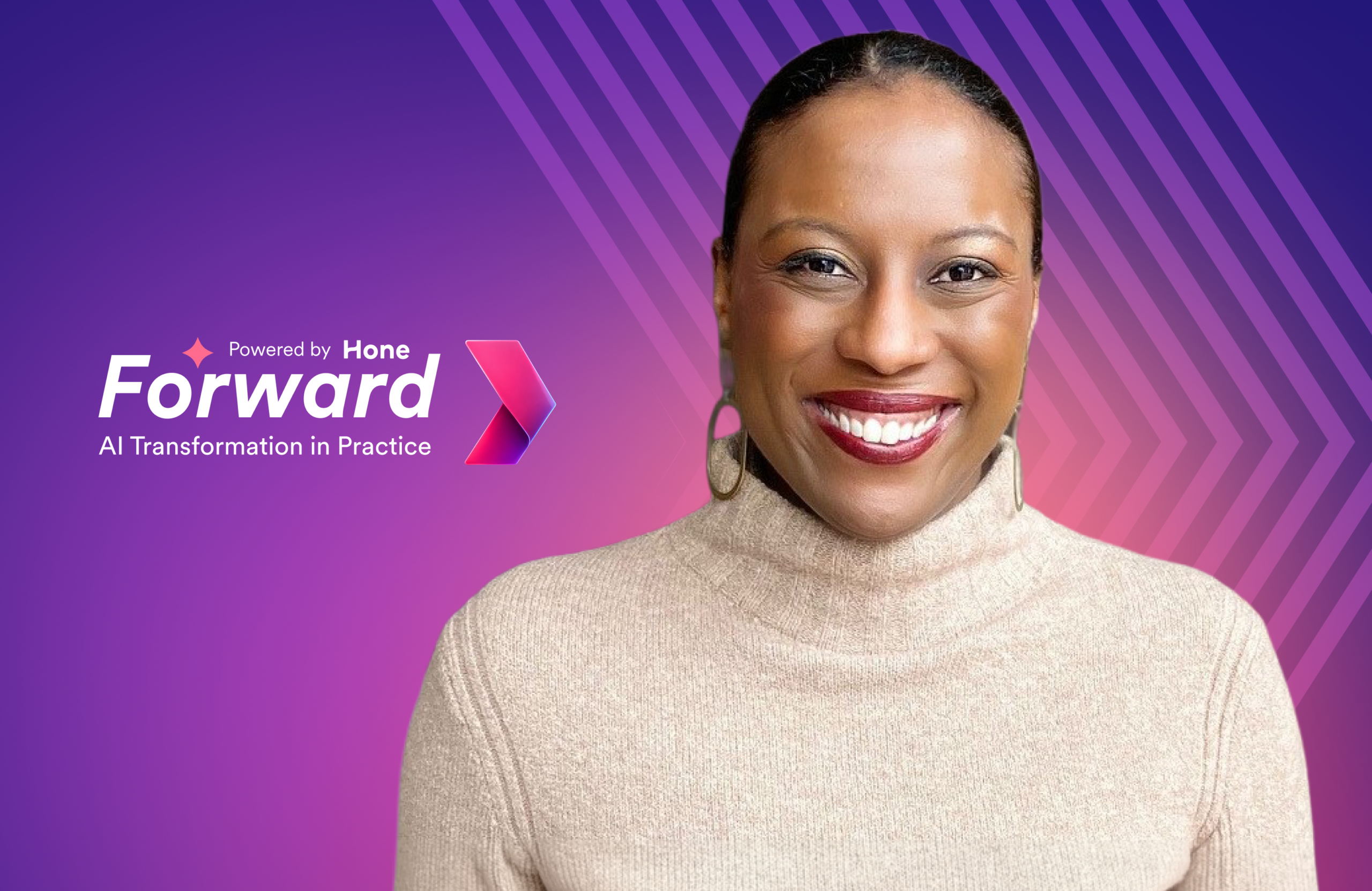
Rea Rotholz; VP, Solutions at Hone: Our next session is called Beyond Adoption, Designing Human Capability in the Age of AI. Czarina Ramsay will unpack the hidden decisions AI is quietly adding to how we work, what that means for our human capabilities, and how organizations can design the conditions to strengthen judgment, foster agency, and improve performance where work actually happens. Czarina is the leadership and capability strategist who has spent nearly two decades helping organizations, you may have heard of some of these, Walgreens, Starbucks, and Meta, navigate change and prepare leaders for the future of work. Hi, Czarina.
I’m excited to bring the mic over to you.
Czarina Ramsay, Leadership & Capability Strategist: Thank you so much.
It’s such an honor to be with this group today.
Gosh, thank you so much for that warm introduction. I’m delighted to be here and talk with everyone about building human capability in the age of first of all, I want to share that this conversation is critical because AI is changing how work gets done and what it means to lead and learn and contribute. So my hope today is that we look beyond adoption and consider how we preserve our agency to make more intentional choices about the role AI plays in our work.
And to kick things off, I thought we might do a quick little poll. So whether you wanna do a show of hands or just drop a a response in the chat, I want you to think about the first real task that you did today, something you had to produce, decide, or create. I’d like to know who used AI?
Okay. I’m seeing a lot of hands.
Thank you for indulging me in that.
Alright. So as people continue to throw their responses in, I wanna also know who let AI make the final call?
Okay. I’m also seeing some folks, not not quite yet. It’s early in the Bay Area. It’s early for me too.
I’m sure that there are a lot of different approaches to what happened and there are different reasons for that. And I think that’s what I really wanna hone in on today. There’s a difference between using AI and then also deciding where we trust AI to do the work. And it’s that difference that is really what I wanna talk about today.
So, I want to introduce you all to, somebody who’s super important to me. This is my Tio Lucho and he lives in Panama City, Panama.
Tio stands for uncle in Spanish. And I was visiting him, last April and I took this picture and there was something about it that caught my attention. I’m curious to know for you, what do you notice about this picture? Drop your comments in the chat.
Okay, I’m seeing a combination of newspaper art.
He’s actually reading the newspaper, great smile, the outside view, no electronics, no tech, his smile happy, yes, all of these things are very true about my uncle.
Papers in Spanish, yes.
Thank you for indulging me in that. So yes, for me, it was the newspaper. This actually sparked a very interesting conversation between he and I. He reads it every day. It’s his personal ritual and it’s something that he chooses to do.
And the conversation that we were having provoked me to think about how I choose to read the news. I pick up my phone and before I’ve read a single story, there’s an algorithm that has already decided what I see, what comes first and what comes next. I think it’s important to keep in mind that neither way is better. What struck me was thinking about how many decisions I had delegated without ever deciding to, and I really think that AI is putting more of those choices in front of us every day. And that’s the core idea that I want to leave with you today.
It’s that technology can be deployed, but judgment has to be developed. We can buy the tools, give people access, and train people on features, but knowing when to use AI, how to use it, and when not to use it, that is a human capability It takes practice, and so the goal isn’t simply more usage, it’s better decisions about where AI truly belongs.
So I wanna try something else. Let’s think about something that’s actually sitting on your to do list right now. It could be an email, a decision, a difficult conversation, or something that you need to create.
Don’t overthink it. I just want you to look at these three choices and kind of identify what’s your instinct. Do you think, partner, or delegate? Just throw one of those words in the chat.
And if I could get a little help, what are we seeing? What do we think for the most most part we’re hearing from folks?
I’m seeing a lot of partner, partner, think, depends.
Partner with a side of think, yep,
Yeah, thank you for sharing. So I want us to look at that. The same three choices are happening and we’re already making different calls.
Because now almost every meaningful task contains a choice.
I can think, so that means I’m gonna do the work myself. I can partner, work through it with AI, or I can delegate, I can hand over the task.
Really what I want you to think about here is that agency is noticing that the choice is there. Judgment is choosing well, and there isn’t one universally right answer. That’s my point. The capability is knowing how to choose based on what the moment requires.
So let’s make this more concrete and look at an example that can feel real for us in our daily work, a performance conversation.
So imagine a manager is preparing for a difficult conversation regarding performance. The manager starts by identifying the problem to solve and bringing the context that AI doesn’t have.
AI can do a lot of the prep work, it can summarize the year, draft talking points, surface patterns, and even suggest questions. But the leader still has to make the judgment about what’s fair, understand the context of the relationship, and take accountability for what’s happening next, right, or what happens next. So in other words, AI can prepare, but the leader has to own it.
And this is why I think leadership becomes even more important in the age of AI. As AI gets better at producing information, generating options, and getting us to answers faster, the leader’s value starts to shift. It becomes less about having the first answer and more about knowing what matters.
What fits the context?
What’s worth acting on? And what are you willing to be accountable for? So leadership isn’t disappearing, it’s just moving. And I think that raises the bar for leaders.
And if that raises the bar for our leaders, it also raises the bar for how we develop them.
Training people to use a tool is not the same thing as building capability. We can activate licenses, complete training, watch usage increase, and still not know whether or not people are making better decisions. So adoption tells us that the technology is being used, but capability tells us people know what to do with it. And that requires a different strategy.
So what does a capability strategy actually look like? I personally think that there are three moves here.
First, you discover how are people already approaching AI?
Next, design. Where should AI help? And where do we deliberately preserve human judgment? And then lastly, develop. How do we help people get better at making those choices over time?
And so I’d like to introduce you to this idea of archetypes in the context of our instincts. So we bring our own instincts about how work gets done, and it’s those instincts that when we make a little bit more visible, we have an understanding of the ways that we work, right? So I wanna introduce you to six AI archetypes. Think of these as default modes of engagement. So these are patterns that can help us recognize how we naturally approach our work when AI is available. So allow me a few minutes to introduce you to these six archetypes. There’s the craftsman who values mastery and wants to take the first pass.
The collaborator who uses AI as a thought partner and finds they think better in dialogue. Then we have the curator who wants to see the possibilities using AI to widen the options while keeping judgment in their own hands.
The accelerator values speed and is comfortable handing work off when AI can move move it forward. The Guardian believes some work should stay inherently human, particularly when trust relationships or human connections are involved and matter most. And then we have the tinkerer. So the tinkerer learns through experimentation and they wanna try something and see what happens.
I’m curious to know from this audience, which of these sound most like you? Drop in the chat what you think.
I see collaborator coming out the bat, so a lot of tinkerers, collaborator, collaborator.
Yeah.
Depends on the activity or the task. That’s right.
Okay, I’m seeing some hybrids, a little bit of both.
Absolutely Craftsman.
Thank you for that. Keep sharing your archetype. I want to note that none of these are inherently better, each brings a different strength and trade off, and these aren’t personality types or boxes. They’re just patterns that we can notice and learn from, especially as we are like looking at the work and what it calls for, especially when we’re trying to address something different, because if people are starting from different places, building capability can’t just mean teaching everybody how to use AI the same way. I hope that makes sense.
So thanks for that.
So my hope for today’s conversation, is really to shift how we think about development as talent development practitioners. Capability isn’t built only in the classroom, it’s built in the moments when people are actually making these choices.
So we have an opportunity to look beneath the adoption metric and ask ourselves, what choices are individuals making?
What norms are teams reinforcing? And what accountability are organizations creating around how AI is used?
That means development might look like practice, coaching, a nudge, a guardrail, a manager conversation, or performance support.
Our job is to design the conditions that help people to choose well while the work is happening. The future of AI learning isn’t about more courses about AI, it’s about better decisions at work.
And so I wanna leave you with three questions that you can take away with you today.
Where should I think?
Where should I partner?
And what can I delegate?
Tomorrow, before you reach for AI on that first meaningful piece of work, I want you to pause for just a second and ask yourself those three questions.
Then I want you to make a choice because agency isn’t about avoiding AI or using it more, it’s recognizing that you have a choice and choosing deliberately.
And before we wrap up, I wanna give you a moment to turn this into action. You’ll see a few ways on the screen to experiment with how you work with AI. I’d love to encourage you to take a minute to take a screenshot of this slide for your own use. And I’m just gonna read off a couple of the details on here just so you have an idea. So as you decide to name your first step, I want you to think about whether or not you pause before you reach for AI. You keep one task fully for your own, delegate a routine task and let go, try AI where you would typically avoid it, partner with AI to expand your thinking, or just bring these questions to your team.
Again, I just want to encourage you to pick one move that you’ll try this week and recognize that as your first step.
And as I close, I want you to think about how you can be more intentional in the way that you work with AI, because ultimately the advantage in this era doesn’t belong to the people who adopt AI the fastest, it belongs to those who know how to work with it intentionally.
And I think, you know, crest of what I wanted to leave with you today is that, you know, use AI where it adds value, but I also want you to use judgment where it matters most. Thank you so much.
And I’ll leave it open for some questions, Rea.
Rea: Thank you so much, Czarina. Yes, if anyone has any questions, you can put them in the chat or in the Q and A functionality. We have a minute or so. Serena, that was really helpful. So many different frameworks for how to think about being intentional. Specifically, I really liked thinking about the difference between agency and judgment.
Czarina: Yeah. Yeah.
That was a big piece of this work that I’m super energized to talk about and welcome ideas and conversations to continue past this.
I feel like we’ve gotten into a place where things are moving so fast that we lose sight of the fact that we can kind of decide how we want to work. This is, you know, the AI era in itself, I think is really a change management phenomenon.
And I had a really cool conversation with one of my friends about this and I said, you know, at one point we all walked and then there was disruptive inventions that changed the options that we had.
We could take a bus, we could drive a car, fly a plane, we could do all of those things in one day or we could walk.
And that’s sort of what inspired this conversation and some of the work that I’ve done around the archetypes and wanting to make it fun again. I think that the conversation has kind of left us with some anxiety, which is totally fair, but we have the power to make it what we want it to be.
So that’s- one hundred percent. Was my point.
Rea: Yeah, one hundred percent. One hundred percent. And I think about just in the HR space, because many people attending today are in the HR space in some way, shape or We did it with COVID, right? COVID was such a huge disruption to the way of working and HR really had a front seat to all of that. And we did it because we are amazing. Yeah. So doing it again, right?
Czarina: That’s right. I think your example is beautiful. We are resilient and agile people. We can modify how we do things based on our needs or the moments that are happening in front of us. And so that’s significant. I wonder if there are some questions that I’m missing.
Rea: Yes. Well, yes, actually we did have a question in the Q and A that apologies I missed. Oh, that’s okay. Which was, could you share any approaches for how leaders can encourage these types of thought processes on their teams?
Czarina: Yeah, well I think it starts with the conversation. I always invite people to let me know how they feel or what they think about whatever it is that we are kind of navigating together. People having space to express their feelings also establishes psychological safety and building that trust to sort of form a norm together. Like I think that, we all have traditional exercises as practitioners that we could lean into in using these conversations. And so I would encourage you to start with how do you feel about AI, one.
Two, use some of the questions that I offer today. How are you using it? When are you using it? Where do you think it matters most? Where would you like to preserve your own capacity for judgment?
Right now, I think broader messaging across companies for the most part has been use, use, use, use, use, but what we’re not necessarily allowing people to do is be thoughtful about use and why we’re using it. And so we’re coming into these murky situations where folks are maybe misusing the technology in ways that are not showing the best for performance. And so I think as leaders, if you’re able to sort of model like an open and honest conversation and then an invitation to create some norms around how you think this could be most effective in the work that you’re doing with some tangible examples and tie it to the life cycle.
It makes sense to maybe lean into AI without thinking about it when it’s collecting information from your conversations.
But it doesn’t mean that AI is gonna have those conversations for you, you have to be prepared to do it. So you just don’t want to lose that.
Rea: One hundred percent. We talk a lot about psychological safety being more important than ever as a people manager and how to foster that on your team.
Which leads me to another question we got which is around addressing the fear of being displaced, right? Yeah. Using AI a lot, like can AI just take my job? Yeah. A fear many people have.
Czarina: Yeah. I don’t have a better way of putting this other than to just face it head on, right? We are not in positions to necessarily say that that’s a situation that won’t or cannot happen because again we’re seeing folks taking different routes to how they want to integrate AI into their organizations.
I think what I found helpful, again, creating the space for people to share how they feel and what they think.
And then I would invite you to use those conversations where you’re getting clear on priorities, ways of working, what goals and objectives you’re trying to achieve. You can even outline in that process where AI fits and where it doesn’t. Because I think what leaders are now going to have to do with more precision moving forward is be clear about where human element has to remain and how you’re contributing to the business in relation to some of those tasks. So I know I’m speaking high level on that, like you probably individually know with greater detail what that looks like within your organization where having a human involved cannot be duplicated or replaced. And I really encourage each person to think about how do they amplify that in communicating what the goals and the priorities are of the team and the work that they produce moving forward. So hopefully that’s helpful.
Rea: Yeah, absolutely. Czarina, this whole session was super helpful. Good, thank you so Yes, this was wonderful. We’re gonna go ahead and welcome everyone to join our next session starting in two minutes.
We have a panel on something a lot of organizations are running into right now, how to get past the experimentation phase into more of the transformation phase. We have leaders from GitLab, Docebo, Rippling and Greenhouse on a panel. So you’ll wanna exit this session, go back to the lobby, enter the next session, and we will see you there. Thank you so much.
Czarina: Thank you everyone. Bye bye.


