













The emergence of AI only emphasized what we already knew: the workforce and the skills needed to thrive in it are changing—fast.
Now more than ever, you need tools to analyze employee skills accurately, efficiently, and at scale so you can identify and close skills gaps. Leveraging these tools effectively will keep your organization competitive, agile, and resilient in a dynamic work environment.
Recently, our webinar “Skills Analysis: Seeing Employee Capability Clearly in the Age of AI,” introduced the skills intelligence tool that HR and L&D teams have been looking for: AI Skills Analysis, the latest innovation in the Hone AI suite.
In this recap, we break down what’s changing about skills evaluation in the age of AI — and what it takes to move from surface-level training metrics to real skill measurement. You’ll walk away with practical examples and expert insights to help you build a more data-informed, skills-based development strategy.
Key Takeaways
- AI-driven skill disruption and workplace change mean organizations need tools to effectively evaluate employee skills, identify skills gaps, and recommend targeted learning interventions to build employee competencies.
- Hone’s new AI Skills Analysis feature gives employees clear, actionable insight into their skill proficiency, areas of improvement, and tailored learning pathways to close skills gaps.
What Is AI Skills Analysis?
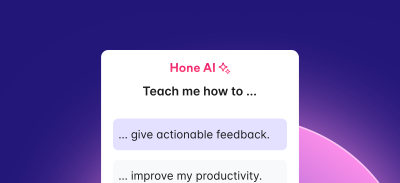
AI Skills Analysis is a feature within the Hone AI suite that gives employees insights into their specific strengths, where they need to grow, and targeted learning interventions to elevate their skills.
Employees receive instant feedback on coaching, collaboration, and other key leadership skills practiced in Hone AI Lessons and Roleplays, then get tailored next-step learning recommendations based on identified skills gaps. This approach makes skills visible, measurable, and reinforceable.
With Hone AI Skills Analysis, HR and L&D teams can equip employees with:
- A research-based skills model built for modern work: AI Skills Analysis is grounded in Hone’s curated selection of 50+ high-impact skills. These skills were chosen based on learner survey data, competitor trends, and the World Economic Forum’s future-of-work research to ensure employees develop skills that are relevant, in demand, and aligned with workforce needs.
- Defined proficiency levels based on observable behaviors: Following each AI Lesson or Roleplay, AI Skills Analysis evaluates an employee’s observable behaviors and assigns a clear proficiency level: Foundational (1), Emerging (2), Proficient (3), Advanced (4), or Masterful (5). This gives employees a clear understanding of what they’re doing well and areas where they need to continue growing.
- Personalized learning pathways tailored to employees’ skill level: Employees receive personalized, AI-powered recommendations, connecting them with targeted learning opportunities that strengthen and reinforce skills.
Individually, these insights are powerful. Together, they create a continuous system for measuring, practicing, and improving real-world skills.
How Does AI Skills Analysis Work?
With AI Skills Analysis, employees can roleplay AI-powered, realistic workplace scenarios and then receive instant, personalized feedback based on their performance. Here’s a step-by-step breakdown of the process:
- Practice a Real-World Scenario: Employees choose the workplace situation or skill they want to work on and roleplay a realistic conversation with Hone AI. They can customize the scenario to reflect an actual work challenge and the personality style of the person they’re preparing to engage with, making the practice highly practical and relevant.
- Receive Clear, Skill-Based Feedback: After the conversation, Hone AI provides an immediate analysis with feedback based on observable behaviors, highlighting strengths, identifying growth areas, and sharing recommended next steps to deepen skills.
- Refine and Reinforce Skills: Employees can immediately apply the feedback in another roleplay session and track how their skills improve over time, turning practice into measurable progress.
According to Sabrina Creighton, our Senior Director of Learning Experience and Coaching, by evaluating skills against clear criteria and suggesting tailored learning pathways, AI Skills Analysis takes organizations from the first level in Kirkpatrick’s Model of training evaluation (“Did learners enjoy the training?”) to the second level (“Did learners actually build the skill?”).
“We really desire to get to level two, where you’re actually assessing learning, and this is where our skills intelligence changes that conversation,” says Creighton.
The Rising Importance of Skills Analysis in the Age of AI
The need for skills analysis—the process of identifying, assessing, and interpreting skills across your organization—has never been greater.
AI is rapidly changing, automating, and disrupting jobs across industries. And according to the World Economic Forum’s 2025 Future of Jobs Report, employers expect 39% of workers’ core skills to change as a result.
With the skills necessary for today’s workforce evolving, Hone’s CEO Tom Griffiths says HR teams need tools to accurately assess employees’ skills so they can identify and bridge skills gaps tied to the future of work.
“The workplace, especially in the talent development space, is very dynamic, and we need better tools to both analyze that and help people close skills gaps,” he says.
Ironically, the gaps many organizations are trying to close aren’t just in AI literacy. In fact, uniquely human skills like adaptability and critical thinking have become increasingly important at a time when AI can automate 57% of U.S. work hours, according to 2025 McKinsey research.
These skills are especially critical for leaders and managers as they must coach employees on a micro level while also leading organizations through the enormous change brought on by AI.
“The leadership of change and the agility and resilience that takes are fundamentally human skills,” says Griffiths. “And the great news is that AI can help us learn and teach those skills.”
Specifically, tools like AI Skills Analysis make employee competencies visible and measurable while recommending personalized learning paths tailored to those skills gaps.
This way, managers can hone the human skills needed to guide teams through AI-driven change and elevate performance.
Why Does Skills Intelligence Matter?
Skills intelligence—the use of AI and other technologies to collect, analyze, and interpret skills data—is important because “it creates visibility into skill development in a way that supports reflection, practice, and application,” says Sabrina Creighton.
This makes learning feel meaningful, relevant, and concrete, which keeps employees on the path of actually learning the skills needed for today’s constantly changing workplace.
For example, say you’re a manager practicing delivering tough feedback with an AI roleplay. The AI evaluates your performance in real-time, providing a visual rubric and step-by-step guidance afterwards that you can immediately apply to the meeting where you have to share the feedback.
In this way, skills intelligence gives managers, leaders, and teams the objective data and actionable insights needed to improve in their roles, making learning immediately useful.
This skills-based employee development approach also aligns with the core principles of educator Malcolm Knowles’ Adult Learning Theory.
According to this theory, adult learners need:
- Clear ownership of their growth
- Reflection on their own experiences
- Immediate relevance to their work
- Practice, not just instruction
- Intrinsic motivation
This brings us back to Hone AI’s feature, AI Skills Analysis. The feature is rooted in Knowles’ Adult Learning Theory, helping your organization close employee competency gaps and build the skills that matter most.
4 Ways to Use AI Skills Analysis for Employee Development
HR and L&D leaders can use AI Skills Analysis to enhance employee development—from making skill development visible to driving continuous, personalized learning. Here’s how.
1) Make Skill Development Visible
Many AI coaches provide generic feedback, merely classifying managers’ skills as “good” or “bad” based on vague criteria.
However, AI Skills Analysis makes evaluation clear and objective by using a behavioral rubric to assess employees’ observable behaviors during a Hone AI session. Each of Hone’s 50 skills is defined across five proficiency levels, resulting in 250 total skill-level descriptors that anchor every assessment in specific, observable criteria.
According to Creighton, this “gives people a real and concrete understanding of what they’re doing well and what to work on next.”
For example, after completing a Hone AI Lesson or Roleplay, employees receive an instant skills report that rates their proficiency on a scale from 1 to 5. The report includes specific examples from their AI session, clearly explaining why a skill (such as coaching) was assessed as “proficient” instead of “advanced” or “masterful.”
By tying feedback directly to observable behaviors, employees can identify performance patterns (like failing to ask follow-up questions to understand a direct report’s core challenge) and make adjustments. This clarity helps them intentionally practice the behaviors required to reach higher proficiency levels and build lasting capability.
In the coming months, AI Skills Analysis will give HR and L&D leaders visibility into their teams’ skill-building progress and growth trends, enabling them to identify gaps, track progress, and sharpen skills in real-time.
2) Help Managers Master Tough Conversations Before They Happen in Real Life
Managers regularly navigate high-stakes conversations like performance and promotion discussions.
Hone AI gives leaders a safe space to practice these conversations so they can refine their coaching or conflict management skills before meeting with a teammate or direct report.
With AI Skills Analysis, managers receive instant, behavior-based feedback that highlights what they’re doing well and where they may need more practice. This helps leaders refine their approach before stepping into the real conversation.
For instance, a manager might want to practice delivering feedback to a direct report who struggles with teamwork skills and has been defensive in previous one-on-ones.
With Hone AI, managers can customize the roleplay to their exact situation, sharing details about the direct report and how they might potentially react. After the roleplay, they receive immediate, behavior-based feedback on how effectively they delivered the message, allowing them to refine their approach before it happens in the real world. That way, managers “[build] skills under conditions that more closely resemble real conversations,” says Creighton.
3) Accelerate Application With Actionable AI Insights
After a Hone AI Lesson or Roleplay, AI Skills Analysis delivers instant, high-quality feedback that employees can immediately apply to their next meeting, project, or conversation.
For example, say a mid-level manager is practicing how to request additional resources for employee training, and they need to run it by a cautious senior leader focused on ROI.
With Hone AI, they can roleplay that exact situation. After the roleplay, the AI Skills Analysis reveals to the manager that their clear and confident communication is a strength and their failure to connect additional training resources to business objectives is an opportunity.
Hone AI also provides skills-based next steps like “You could improve your persuasion skills by explaining how past training investments boosted company ROI.”
Instead of vague feedback, the manager receives precise, behavior-based guidance on what to improve and how to improve it, so they can walk into their next leadership meeting more prepared, persuasive, and effective.
4) Drive Continuous, Personalized Growth
A 2024 TalentLMS and Vyond survey found that 80% of employees think personalized learning is important. Creighton says, “that’s exactly the shift that skills intelligence gives us: the ability to move away from one-size-fits-all to ‘tailored to [your] needs.’”
For instance, if a manager’s collaboration skills aren’t up to par, AI Skills Analysis might prompt them to check out Hone’s AI Lesson “Collaborate with Clarity.”
These tailored recommendations help an employee close their unique competency gaps and reach new levels of proficiency through continuous, relevant, and skill-specific training.
From actionable feedback to tailored learning pathways, AI Skills Analysis gives HR and L&D teams exactly what’s needed to accelerate employee skill development and unlock stronger performance.
Close Skills Gaps With AI Skills Analysis
To close skills gaps across your organization, your team needs clear visibility into where their competencies stand and specific guidance on how to elevate their skills to the next level. Fortunately, Hone’s AI Skills Analysis provides both.
By objectively measuring skills against clear criteria, providing instant and actionable feedback employees can immediately apply, and recommending personalized learning pathways tailored to their skill level, Hone turns skill development into a measurable, continuous process.
Ready to see employee capabilities clearly and close gaps confidently? Book a free, two-week trial today to see AI Skills Analysis in action.
FAQs
What is AI Skills Analysis?
AI Skills Analysis is the latest innovation in the Hone AI suite that gives employees actionable insights into their strengths and growth areas and provides personalized learning recommendations to strengthen their skills.
How Can Companies Use AI to Find and Close Skills Gaps?
Companies can use AI skills intelligence tools to evaluate employees’ existing skills, identify gaps, and recommend targeted learning pathways to help employees bridge those gaps. For example, Hone’s AI Skills Analysis assesses employee capabilities against defined behavioral criteria and provides instant feedback on strengths and growth areas to help employees elevate their skills.
What is the Best AI for Skills Analysis?
The best AI for skills analysis is Hone’s AI Skills Analysis, which evaluates employees’ skills to identify strengths and growth areas based on observable behaviors and recommends targeted learning resources for specific skill proficiency levels.
What Benefits Does AI Provide in Skills Gap Analysis?
AI enhances skill gap analysis by automating data collection, using predictive analytics to forecast skill shortages, and providing real-time, personalized insights instead of relying on manual, bias-prone self-assessments.


