Welcome officially to today's webinar, How to Bring AI into HR Processes Without Losing the Human Touch.
A few quick housekeeping notes before we get started. Live transcription is enabled for today's webinar, so you can click the show captions at the bottom of your Zoom window. This webinar will be recorded. We always have people ask. Don't worry, it'll be recorded. You'll be able to share it with your colleagues if they missed it.
And then we want to hear your questions. So Jasmine and I will be monitoring the chat, but if you do have a specific question that you want us to ask or even post to the group, put it in the Q and A, we will have time to get to those throughout the presentation as well.
So with that, hello everyone. I'm Rea Rotholz. I lead Hone's learning solutions team. I've been with Hone for about four and a half years now, where I get to advise our customers on L and D best practices, how to close their skill gaps, how to measure the success of their learning experiences.
And I work with organizations of all sizes and all industry types. Prior to joining Hone, I led learning and development at Dow Jones. That's the parent company of the Wall Street Journal and some other media publications. I was in house learning and development before coming over to Hone.
And prior to that, I was in various consulting roles, employee engagement, corporate culture. So it's been really fascinating seeing everything going on with AI and AI transformation in the HR space. Really excited to chat with you today about it.
And I mentioned I am here from Hone. Hone is an AI powered people development platform that helps organizations with leadership development and AI transformation through our unique blend of live instructor led classes and AI powered development experiences. And like I mentioned, we partner with companies of all sizes.
I am super excited to be here with Jasmine. I met Jasmine about two years ago as a home customer, and I got to meet her in person in Denver last July, which was super fun when I get to meet people in person. But I'll kick it off to Jasmine, and she can introduce herself and share a little bit about Xactly.
Hello, everyone. My name is Jasmine Pearl, and I am Xactly's senior talent programs manager. I am coming up on five years at Exactly, which is really hard to believe.
Before joining Exactly, I worked in recruiting in healthcare and then transitioned into some DE and I work and culture work. And now I am responsible for our talent programs, and I'm really excited to be here today. Exactly is an intelligent revenue platform backed by twenty years of data and supported by AI. We simplify the complex mechanics of sales performance like forecasting, quotas, and incentive design, because we know that compensation is ultimately rooted in human motivation. When people clearly see and trust how they're being rewarded, it builds engagement and drives success. So really fun to talk about how we use AI in our products and how we're using it internally.
Thank you, Jasmine. So Jasmine is in house at Exactly, HR practitioner who has been living through AI transformation at her technology company. Me coming from home, I kind of sit across all of our customers, I'll be able to share perspective of what I'm hearing, you know, trend wise, different industries, etcetera. So we're bringing a great mix today.
So for today, we have a jam packed agenda. So first, I'll share a little bit about what we're seeing in terms of AI in HR in general, and really the climate that we're facing.
Jasmine will share more about what her team at Exactly has done with performance management specifically.
And what she's sharing can be applied to any size organization. I'm sure many of you are thinking about your performance management processes, so hopefully you'll get some good tips.
We'll talk about the biggest consideration when it comes to AI in HR, which is this balance of technology and humanity, frankly, and human judgment. And then we'll share some lessons along the way and key takeaways that you can potentially try back at your organizations. So we'll be together for the next hour. As a reminder, definitely use the chat. We want to hear from you throughout and you can ask any questions.
So first chat question for you all, so get ready.
Post in the chat, what challenges have you come up against when you've tried to implement AI in an organizational process?
Doesn't have to be performance management, but we heard a lot here in the chat already.
Employee relations, recruiting, onboarding, training, like you have definitely been leveraging AI. What are some of the challenges that you have faced or blockers or things stakeholders have said when it comes to implementing AI in HR?
Would love to hear from you in the chat. We'll give you a second.
I will also post the question for those of you who are visual learners like me and you need to read something.
I know that's helpful for me, so let me do that.
I'm seeing trust come up a couple of times, which is something that I think everyone is working through.
One hundred percent. We're going talk more about that for sure. Funding and resources.
Shannon says internal company policies. Absolutely.
Integrations, Josie.
We'll talk about that as well.
How can we share consistent use and practices, proprietary content being safe to share, security and IT approvals for integrations, company policy? I'm curious for those of you saying company policies, is it that there's no policy or does it feel like the policy is too stringent to try something?
Curious.
Rebecca says no human touch.
I'm excited to dive into more of that today.
Hopefully, Rebecca, I can learn from you and you can learn from me a little bit about what we've done.
Maintaining my own voice, cost of adoption.
AI is another thing on top of my day job. That's an interesting one, Minji.
Okay, amazing. Keep it coming. Part of this is we are all in this together as HR practitioners. We're all facing similar challenges or at least certain challenges.
And so we can definitely learn from each other. Thank you all for your chat. So on the left, my daughter loved this slide. She's five.
She had a unicorn birthday last weekend.
But on the left is the idea of AI is unlocking so much for organizations, right? Capacity, efficiency, the ability to do new workflows that we were never frankly able to do before. It really seems almost mystical that we can hypothetically do anything right now with HR in a lot of ways. And the reality is in HR, we are more on the right side, which is blockers, which we've heard from a lot of you, whether it's corporate policies or, internal stakeholders or security.
The HR space tends to have a real sensitivity to implementing new tools, especially when it comes around employee data, right?
Historically, HR has had a mission to protect both the company, but also individual employees. And also HR tends to be this sort of like, I think, this A plus student where we don't necessarily have permission to fail in the same way that other departments might be able to try something and fail and move on, especially if our employees are at stake.
So we haven't had that luxury historically, I feel like.
And right now, someone said this in the chat as well, there's so many different ways that we could use HR, and there's so many different point solutions out there for HR. Specific things for recruiting, specific things for onboarding, specific things for L and D, etcetera, that we can also get this sort of analysis paralysis. And they don't always integrate, right? A few people said integrations there, so it won't feel as comprehensive or cohesive for an individual employee.
Anyway, so the question that we have and that we're gonna answer today with Jasmine here is where can we identify opportunities to leverage AI in HR that isn't going to necessarily create thrash, but can really provide great impact for the organization?
So fundamentally at home, we believe that AI should be employees copilot, right? So not replacing employees by any means. We're big proponents of using AI internally at home and for our customers to be using AI as well. And this is a philosophy that we share with our customers. Certainly part of why we were excited to do today's webinar with Jasmine is we share a similar philosophy, this co pilot philosophy with So I'm curious, Jasmine, to get us started, if you can share a bit about Xactly's stance on AI with our audience today.
Yeah. So Xactly believes that AI is here to enhance our capabilities. We have employees around the globe with about half of them being in India, about forty ish percent in North America, and then some other folks scattered around the globe. But we believe that AI can support all of the employees given the right tools and education. We actually have a leader, her name is Megan, she's my leader. And her stance is that we have to be constantly experimenting and trying.
Actually has banned the word wait. We're not allowed to wait for things to be perfect. We're not allowed to wait for the best of the best solutions to come about. She wants us to be iterating constantly on the processes that we have to see how we can continue to enhance them for the sake of our business and our employees. So in general, our stance is that humans should be on the loop. We're orchestrators of the AI, we're orchestrators of our programs and policies. We're not passing off our jobs completely to AI and expecting it to drive our business success.
So what happens if you say that you're waiting for, to use people in the chat, waiting for a budget, waiting for a policy to be approved? I'm just curious, like what would happen if you were to say that?
Megan is a very personable, warm leader.
And I think the only time I've ever heard her interrupt someone is when they say, Oh, I'm waiting for something. Or, So and so was waiting. She's like, Wait, what? Are we doing? Why? And she helps us try to rethink what we could do to move around whatever the blocker is, either a physical blocker or the blocker in our minds.
Yeah, part of this is nailing down what that blocker is. And then you can leverage, Megan is the Chief People Officer, of course, but you can leverage senior leader to build that case and work through that blocker. Yeah, that's interesting, the idea of wait.
Thanks, Jasmine. So Jasmine, why don't you share a little bit about why performance reviews and what you all have done at Exactly?
Yes. So before I jump into that, I'm curious when you hear that we are using AI in our performance reviews, what you think the potential pros or cons of using AI might be. And if you've used AI in your performance reviews, what the pros and cons have been for you and your organization.
I don't think I saw anyone say performance reviews in HR processes, the first question we ask. Right? So that's interesting. I'm curious.
Kathleen says they're using AI, I'm guessing this is a pro, to mitigate biases, which I've seen built into some of the systems that we use.
Yeah, so I'll continue to monitor this chat, helping improve the feedback given.
Yeah. Okay. So let's dive into why we used AI in performance reviews at all, and I can chat a little bit about some of the pros and cons that we've seen along the way.
So, Xactly is going through an evolution of performance management. We abandoned an old way a couple of years ago, actually right before meeting Reya, of how we were doing and thinking about performance management to really modernize the approach.
So today, we run annual performance reviews with a midyear check-in, and we use Lattice as the platform to manage all of our performance processes.
We offer a self review and a manager downward review. And it's mostly tied to objectives and our competencies. However, we do include scoring on the manager side. It's a big lift with all of that, right? You're asking for everyone in the organization to participate, to set aside time in their already busy day to day schedules, to think back at what they've done, to look through the feedback that they've received over the course of the last six months to a year, to summarize their accomplishments and hopefully provide enough information that they can use this information to propel them into the next iteration of their development.
It's a lot.
I know that performance management and reviews itself are sometimes the dreaded process for both HR professionals and employees. So we wanted to overhaul the entire performance management cycle, and this is continuing to iterate. So we're not even locked in today to what we're doing.
We're still understanding our employees' relationship and interest in AI, but thought, wow, with such a big lift, such big effort, and sometimes low consistency in how the reviews are executed, what could we do to make all of this better and more efficient for our employees?
We also recognize the gap between the manager expectations and the employee output. So we wanted to move our performance reviews from not just what did you do, but what was your impact? How did you actually help the business drive towards success?
And what we found was that there's really a blank page problem. It's hard to stare at a blank canvas or a blank paper and start to think through all that you've accomplished and all that you've done. And we find that employees typically wait until the last minute to start their reviews because they're overwhelmed by just getting started, which leads to downstream effects on their development because now they're rushing to get these done by the deadline and maybe they're not able to provide the most robust look back as possible.
So, we also have been having leaders encouraging us to consider how AI can support all of our existing workflows and workflows that we might want to do but haven't started yet. So we recently did something, we're calling it the heat map exercise, where across the business, employees are thinking through what they actually do in their jobs, writing it out, assessing how much time it actually takes them, and then we've got formulas built in to determine the lift and maybe the areas that you'll invest in AI to be more useful for.
So today at Exactly, we have Gemini Business License.
Some of our teams are using things like Cursor and Claude. And then a performance management system, like I mentioned, is Lattice.
We found that people are kind of dispersed in how they're using AI. Some people are using gems that they've created by themselves to track their wins and feedback over the course of the year. But for a lot of our employees who are still AI curious, but maybe not diving into it or doesn't have one of their AI tools on their screen constantly throughout the day, it wasn't a good solution to encourage everyone to now go create their own gyms. So, we've had great success with homes learning, and when they announced the AI Coach, it got our wheels turning. I think we talked with Raya and Samara, and we're discussing what it would look like to use the AI Coach as we're doing performance management.
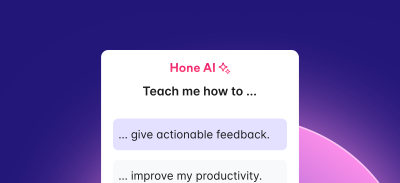
The idea that we came up with was embedding AI prompts into the actual performance review to increase adoption because it reduces the click path from here's a resource that you can use on one screen, but you also have to have your performance review open on another. And we positioned it to the team as a coach. So we have Honed AI Coach. You can ask very specific questions. It's using the learning and training that you're already familiar with, and it has information about what your role is. So we've embedded these fill in the blank prompts that employees could then personalize in the AI coach.
I think part of what's interesting about what exactly did is it was almost Mad Libs style.
So sometimes when we say, Oh, you can use AI for your performance review, you're still dealing with the blank page problem because someone has to think about what they want to prompt. And even that can be a little bit like analysis paralysis. I don't know exactly how to prompt this. So by providing a consistent way for someone to prompt the tool, I think that was also really helpful because it took away the mental load of having to even write out something into AI, right?
Yeah, so employees saw the question that was in the performance review template. They saw one or two prompts, depending on the question itself, that they could then fill in the blank, like you said, with Mad Libs and start to generate their thoughts more. We weren't really doing a question on rewrite what I've written, but it was more so help me think about my impact on the business.
Yep.
So this prompting, again, it wasn't to automate reviews necessarily, it was really to be that copilot, to have someone, quote unquote, someone sitting next to you thinking through your performance, not just what did I do, not just what were my objectives and what did I accomplish, but what changed as a result of my work and how did I help to drive the business forward?
Yeah.
And I see in the chat, there are definitely tools that can summarize all of the I asked Jasmine, use Lattice to summarize all the one on one meeting notes as an example. Because certainly AI is allowing us to overcome recency bias and think about the whole year, upload a lot of context.
But then the balance is, are people having that opportunity to really self reflect deeply on what are they most proud of? What were the downstream impacts that maybe weren't documented in a one on one note or anywhere?
And so you end up sometimes missing all of that human element to the performance review if you are not using AI in a way that's gonna prompt someone to think about that.
Yeah, and it helps us to take a step out of our day to day, right?
Today, I might send a few emails about X, Y, and Z, but something is changing as the result of my participation in the work that's good for me, my team, and my company.
Yep.
And you really struck that balance, I would say.
Adoption for AI. So first for the group here, how many of you in your organizations have an AI mandate? You could put a Y for yes.
I'm curious if your organization has said like, yes, people have to be using AI. It's coming from the top. Maybe it's not fully defined, frankly. Definitely have heard that from customers.
So curious. Okay. I see why's here. I see a few ends.
Okay, interesting. No, but encouraged.
Yeah, I'd be curious. So for those of you, both anyone, whether you put a Y or an N, what is one way that the organization or you in HR has helped individuals start to adopt AI?
If it's mandated, any lessons learned from that? If it's not mandated, what have you all been doing to encourage adoption? We'd love to hear from you. Then of course, we'll hear from Jasmine what they have been doing at Exactly.
But we have a lot of different organizations on the line today.
Enablement. Yep, sharing use cases and wins. I will say a lot of customers at home have talked about show and tells where people can share the real examples of how different teams or departments have been deploying AI tools and workflows. I think that's really helpful.
Training licenses. Yep.
Makes sense. Help people learn about AI. That can definitely help the AI curious who feel a little overwhelmed about using it.
Perfect. Working sessions, AI enablement program.
Wow, ninety percent completion, Sabrina. That's amazing.
Learning workshops.
Yep, Minji always starting at the top, executive leaders sharing the vision. We know that that has a huge impact, right?
Absolutely. Task force availability. Yeah, keep these ideas coming. I think they're all really good for us to learn how people have been addressing this.
And then Jasmine, do you wanna share a little bit about what you all did at Exactly for AI adoption and specifically the performance management adoption as well?
Yes, I'd say that we're still in it, right?
I think AI is consistently evolving and the ideas that we have for how we can use AI are changing every minute.
But one thing that we want to do is that we know that there's been some fear or hesitancy for folks globally around AI. And we wanted to bring in AI here as an opportunity for a supportive resource. This is not something that is going to spit out an answer for you and you have to stick with it, right? This is an opportunity for you to have some assistance in doing something that you were going to do anyway.
Now, for this case in particular, we did keep AI usage optional. Of course, we heavily encouraged it. We had reminder emails talking about, Hey, if you haven't started yet, and if you're overwhelmed by the idea of what all did I do, start with the Hone AI coach, start with the embedded prompts, come back to actually answering the questions later so that you can start to think through what you might want to say. We know that performance reviews are highly personal and we didn't want people to feel like they had to use a tool that maybe they weren't certainly comfortable with yet, but we wanted them to at least explore it. And I think by taking the prompts into HomeAI versus in the actual performance management template, they were able to feel more comfortable about the fact that the tool wasn't gonna automatically feed answers into the text boxes for them.
It was built directly into the flow of work. We know that in change management, the easier you can make it for people to find the resources that they need, the more likely they are to actually use them. So rather than just providing links or telling people, Hey, by the way, you can do this in Hone, we said, It's directly here, you'll see it as you're answering your questions, and that drove people to click on the links and complete the prompts. And we designed it for a global workforce.
So, in the prompting that we did, and I did see some requests for example prompts, I think, Rhea, we have those prepared to share later as follow ups, we wanted to make sure that the language we were using was globally acceptable and, what's the word, relevant. We know that we've got folks across the globe who speak different languages or who interpret things differently. So we went through a series of testing to make sure that the prompts we were providing were actually asking the questions that people would be hearing.
That makes sense.
I think one of the most interesting things, and it feels obvious in hindsight, frankly, but one of the most interesting things that you all did was the embedding Hone or whatever AI tool you're using into the actual Lattice experience. And I have shared this case study now with other Hone customers who are using Workday or whatever the tool is to say, Don't have it be separate. You can edit the text box a lot of times and you can include the link right there, so it really doesn't take any effort to click that link and try it out. And I just felt like that was I assume it was your idea, Jasmine, but I just thought that was a really good idea.
Thank you. Whatever we can do to make things easier for employees.
Yeah, if we're saying that AI is here to make us more efficient, it is counterintuitive to take people out of their current process.
Yep, absolutely.
So getting to this balance that we're facing in HR in general, which is the automated world, this AI hype, the reality that AI can actually do a lot for us, but balancing it with the need for human judgment, for empathy, for ethics, for fairness, right? All these things that we deeply care about in HR. I feel like often HR is the heartbeat of the organization and the reminder of people still come first, is the people who are making up our organization. And so this is always a balance. And I think everyone of thinks everyone's Everyone thinks that they're doing a great job at this. And Jasmine, you shared with me when we were chatting last week about this, a quick anecdote. Can you share that actually?
Yeah, so there are varying sentiments around AI. We actually just ran our own survey internally to understand where our employees are coming from. When they hear AI, what do they think? What emotions come up for them?
Well, a few weeks back, Exactly hosted our user conference and our keynote speaker was Zach Cass. He is the former CRO of OpenAI. And when asked what he would say to people who are worried about AI replacing them or being automated out of a job, He took a poll, a live poll of the audience, and said, Raise your hand if you're worried about AI taking your job. And these are a lot of folks who work in sales compensation, right?
And maybe out of two forty people, ten or so raised their hand.
And then he asked, Raise your hand if you're worried that AI will take the job of friends or loved ones, and hands went up all over the room. He calls this the zombie apocalypse theory, where he thinks that, or people tend to think that they would survive the zombie apocalypse, but their neighbor, who may be not as intelligent as them as he said, would not. We are seeing that, or he's seeing as he travels around the country, that folks tend to be more concerned about their neighbors than they are themselves, which gave us pause for consideration about the feelings that people were expressing.
We had ninety three percent of our employees say that they're excited or at least curious about AI, and a very small percentage say that they were not interested or hesitant or nervous around AI. But we didn't ask them, how do you feel about AI being used by your teammates? So maybe a follow-up that we need to have. But the lesson here is that we need to have empathy for the feelings that our teams are having.
They're already busy. They're already burdened by what they're doing at work, maybe what's happening at home and in the world. And I think that AI actually allows us to be more human because it takes us out of some of the things that might take five, ten, fifteen minutes and are really kind of redundant and allows us to focus our time on strategy and empathy and building meaningful relationships with the folks we work with.
I love that as the philosophy for AI usage, of course. Someone said in the chat earlier that AI at their organization, and it was in quotes, is another thing to do.
And especially for some organizations where it's a mandate and there might not be the right level of enablement or training or understanding of how to bring people along this massive change management journey that we are sort of all on, it can have a negative impact on people and really drive that anxiety.
So let's put in the chat a why if you would survive the zombie apocalypse.
I would put a no. I don't think I would survive, but I'm sure many of you would. I'm just kidding. But actually, if you want to, would be curious.
Okay. So one of the things that I do love about the Exactly example in particular around performance management is that it actually focus on using AI to synthesize a lot of data or draft the performance review, which we see a lot of. And inherently, that's not a bad thing as long as the human judgment is present. What I love about the prompts that Jasmine used and the way AI was used in the performance review is it actually forced people to think differently and deeper about their accomplishments and the impact that they've had at the organization.
So I don't know if any of you have ever used AI to interview you on something. So whether this is something you're working on or something that you're thinking about or even writing your own bio, whatever it might be, AI is a really powerful interviewer that can ask you the series of follow-up questions that a good reporter would ask in a way. And that can just force you to think more deeply about whatever it is that you're working on. So I do encourage you to try that on any topic with your favorite AI tool, but certainly that's the approach that Exactly took.
I thought that was really unique across our customers. Employees were still very involved in the process. They were involved in writing. It was really their work.
The other thing that I thought was interesting about the Exactly case, and we had someone ask about calibration, and Jasmine, I am going to ask you about how you all handled that because I think that would be interesting.
But the use of AI was kept very non intimidating. It wasn't being used to score or evaluate employees. I feel like we hear in the news about all of these big layoffs and things like that. And there's this fear that a performance review process might lead to something like that.
We can't help it as humans. We see what's happening across industries in the world, right? So the fact that it wasn't used in that way, I think is really a testament to the value Exactly places on its employees. And that really resonates like the culture.
I see you have care behind you on your screen. Those are Exactly's values and they really live them and promote them. And I think that was really felt in how you all decided to tackle AI in your performance reviews. So I am curious and someone asked in the chat about how you did the calibration exercise.
So maybe you could share a little bit about that. Yes.
So both employees and managers were given prompts to help them think more deeply. However, managers, when doing the scoring of their direct reports, it was a simple question, right? There weren't prompts there even for how you should score. We have definitions for what each score means. And the idea is that we want managers to be able to think very thoughtfully about the performance and development of their employees, and then to use the way that they've been thinking to help support their decisions on performance reviews.
There are laws and regulations specifically in the EU around using AI to make compensation decisions, and it's something that we've stayed away from. We have the governance in place to be able to check to make sure what we're doing is actually safe, and we are taking care of our employees, respecting them, and giving them the best that we can.
Makes sense. And I feel like, well, didn't actually know that it's illegal in Europe, so that's good to know.
And of course, as Yeah, go ahead.
There has to be the human on the loop. A human has to have final say over the decision. So there isn't a calculation based upon what you've said here, AI is going to spit out a score and that just is locked in. There has to be some oversight of humans.
Yeah, which I think we're arguing in this webinar that there should always be some oversight of humans and that we shouldn't really outsource any piece without the human judgment component. That makes sense.
Thanks sharing.
So with this performance management rollout, can you share what the results were? Did you see a big difference? I know there were a few changes happening at exactly around performance management, and AI was one small piece of a larger initiative. But yeah, would be curious to hear about your results.
So we actually had one hundred percent on time completion of self reviews, which I like to pat myself on the back for a little bit.
Unreal, unreal. No one gets one hundred percent.
And it was really encouraging to see that eighty six percent of our surveyed employees actually did say they used AI in their performance reviews. So, hopefully that was a driving factor in helping people complete their work on time.
So, beyond just the numbers, we have employees who are more confident and are able to have more productive follow-up conversations and generate actionable IDPs. One of the questions in the performance review was, given what you've said here, what are some of the areas that you would like to drive better performance? What are some of the action plans? And we leaned on Hone again for that to say, Okay, here's what I've decided are my areas for improvement. Here's where I want to become an expert in, in the next year. What recommendations can I make for my own IDP that I can discuss with my manager?
So we had a streamlined review process, which really, if you think about it, performance reviews are meant to drive better performance, right? And if it's not doing that, then we're missing the mark. So to be able to wrap up the entire performance review cycle with actionable IDPs to encourage our employees to keep growing and learning was really exciting. And as a result, ninety four percent said that they understand how their work contributes to exactly success.
These numbers are massive, frankly. And IDP, I assume most people know what that means, but it's individual development plan, to make sure.
Can you share a little bit, because I don't think it was the use of AI, can you share a little bit how you got one hundred percent completion?
Because I know in HR and in L and D, we are constantly trying to get people to complete things, whether it's a compliance training, whether it's a form they need to fill out, whether it's a performance review, like any tips for the group? And for the group, if you have tips on how you've helped people complete the tasks they need to complete, would love to hear from you as well in the chat. But yeah, Jasmine, can you share?
Help us.
We have a very interested workforce.
They're very vocal about what they do and don't like, and every cycle that we run performance reviews, we ask them what worked for you and what didn't. Sabrina said yes, other than threats.
Sabrina, what's the threat though?
Tell it, give us the verbiage we should use.
So we take the feedback that we get from our employees and do our best to implement it in the next cycle or to at least explain why we aren't able to take that approach. And then we do make our changes in the next cycle. We say, Hey, we heard you. We heard what you said and here's what we did about it this time around. We run a very detailed communication plan, starts from the top with our senior leadership team, sending out things like videos or direct emails and messages to managers and employees about the importance of performance reviews and how it will help support their development and their career, even beyond exactly. And we follow-up with our employees, again, like I said, to ask what worked for them. And I think that's helped us to build more trust that we take the reviews very seriously and their development seriously.
And Sabrina just asked, is this via survey feedback or employee engagement feedback survey, that kind of thing?
Both. So we have both anecdotal feedback that our HRBPs are collecting during performance reviews, as well as surveys launched through Lattice. And what's cool is that we can actually see the survey's results are anonymous, but we can do a heat map to see how our higher performers answered questions versus some of the folks who may have been on improvement plans to see what areas we need to improve to support the entire global workforce.
I love that. And in the chat, if you have ideas other than threats as to how you get folks to complete a process or a performance review or take a training or whatever it is, would love to hear. I know we're asked that a lot at home, like what are some best practices here? So would love to hear from you all.
We have some example lessons and takeaways. One thing I would like to do, Jasmine, is to hear a little bit more about the heat map exercise. So when we started in the webinar, we were talking about the blank page and how we landed on performance management as what you decided to leverage AI for. But can you share a little bit more about what that heat map exercise really was in case anyone wants to try it in their organization?
Yes, it was fairly simple. I wasn't a part of the creation of the exercise when I was asked to participate. And when I received it, basically I had my name and some columns and I was asked detail what does my day to day look like? What does my year look like? So I had both the simple things that I'm doing Monday through Friday, and then the larger programs that I'm responsible for. I broke down each of those into what it takes to bring those through completion and how long it takes, how many people are involved. And then there was a calculation that ranked on a scale from one to five, the effort level and potential for AI to help reduce some of the manual work so that we could spend more time strategizing and rolling things out that were good for the business.
And each team did this out exactly? Each team did this, yes.
Have an AI council who is constantly looking for ways to train our teams and make investments into AI tools that make sense. So, they orchestrated this and we just had to send it back to them.
Yeah. So, for those of you on the line, this is something you could do with your own team in HR. So, you can audit your own processes that you're doing in recruiting or onboarding or learning and development and sort of do effort versus impact and see where maybe AI can play a role. Sounds like exactly did this more oh, yeah. Was this something home provided? No. This was something exactly built.
And it sounds like you had an AI council who worked on it.
Yeah. Very cool.
So one of the first things that we talked about was finding the blank page. So there's also this opportunity of where are people stuck because it feels too hard to start.
I know I'm a big proponent of not starting with a blank page, I'm a big fan of brainstorming with AI first. It's much easier to edit.
So think about even on your own team or for your managers, where is there a blank page?
Oh, Brad, love the detailed communication. Yes, support from the top makes a huge difference. We've heard that from a few people in the chat as well. Getting your senior leaders on board, whether it's a mandate or not, it's more about senior leaders role modeling and talking about the vision and how their excitement around it, right?
Reya, one thing that we've learned just dealing, working with our leaders, directors, managers, etcetera, is that we have a fairly competitive team.
So sometimes we will I did this most recently between HR and marketing. I said for the engagement survey, HR and marketing are tied neck and neck for first place completion.
Survey goes on the of who's going to win, right? And now the execs are like, wait a minute, this other executive and I are racing to the finish. And it makes it a little bit more fun and challenging, but also encourages them to prioritize it and cascade the message down to their teams.
I love that, a little bit of fun embedded in the culture. I feel like sometimes we take things a little bit seriously, so that's really fun. Good idea to get completion rates.
So identifying the friction points is step one. Step two, we talked a little bit about responsible adoption. So of course, we are still in most of us are in the HR space. We do have that history of being risk adverse.
It sounds like the Chief People Officer at Exactly, Megan, has sort of overcome some of that risk aversion with the, we don't talk about waiting. Like, you're not waiting for something. There's always things you can be doing. If there's blockers in the way, you can be facilitating help to get rid of those blockers, right?
So that's an HR leader role modeling the idea of experimentation and taking risks and being okay to fail. So again, that senior leader really buying into it and role modeling and supporting the culture on the team, which can make a huge impact. But of course, there has to be guardrails in place. A lot of people mention that AI policies might be getting in the way of trying new things.
So you do have to obviously operate within those policies.
But I also know from our customers that those policies are also changing.
So a year ago, we had people say, oh, we can't use AI in anything. Like that was really the case for a lot of organizations.
And now as the businesses change, as the world change, as we get more proficient in how AI can be used and how the data is secure, those policies can also change. So something might feel set in stone now, but might not be the case six months from now. We just have no way of knowing. We're all iterating.
And then finally, turning curiosity into action. So Jasmine, I love you said this earlier, this idea of some people at Exactly are still in the AI curious phase of AI transformation, right? They might not feel super comfortable using AI tools. And as the people people at work, we have to be conscious and empathetic to everyone's individual experience.
And so meeting people where they are, making sure they have the enablement, making sure they can dip their toes is really important. And then on the flip side, providing the same level of support and tools and opportunities for those that might be more AI competent at the organization. I know exactly has the spectrum, right? Depending on the team and where they are globally.
And I'm sure many of you on the line have the same, right? People are in different phases. And as an organization, you're somewhere on the map between AI curious and AI competent.
And then the final thing, and I know some people mentioned this in the chat, is just the importance of the change management piece and the communication. At its core, change management is based on empathy and meeting people where they are and bringing them along on the journey. And so I love that with the performance management, you use it as a way to not replace something, but to make people think deeper, self reflect, and have a more powerful performance review. So I thought that was just a really interesting way of approaching it. Yeah, is Tendi.
Yeah, go ahead. I attended, oh my goodness, Transform recently and was really interested in meeting with people and learning who in their organization owns AI transformation, whether that's technical teams or the people teams. And we're of the mindset that you cannot have the transformation that you really desire that changes outcomes if you don't have people at the center of this change management idea. So it's great to have all of the tools and processes and governance policies, but if no one's using them or isn't aware of them or isn't sure how to approach them, then the other two components don't really work for anything.
One hundred percent.
Yeah. And it always seems like, of course, but when you're living it and there's potentially a mandate from the top and it's like, oh, we have to get adoption. We try and move so quickly that we don't always take the time to figure out how to bring people on the journey. And I know this is the reality many of us are facing in L and D and the HR space.
Well, if any, we have a couple more minutes. If any of you have any specific questions for Jasmine or myself or for the group on the line, feel free to put it in the chat.
And while you do that, I would also like to offer you all to try Hone. So I do see many Hone customers. Hello, everyone. Thank you for joining.
And some potential customers that we're talking to. But if you're new to hone and you want to try our AI coach, you can do so for free. No strings attached. You can sign up with this QR code on your phone or use the Bitly link and you can see what the tool was that Jasmine embedded into Lattice for her performance reviews. You've kind of experienced yourself. So highly encourage that. Oh, thanks Sabrina.
But any last thoughts from the group or Jasmine from you?
Well, one, Rhea, I don't know if you saw it, but we have a few people who are confident that they would survive the zombie apocalypse and already have go bags ready. So I think that I would like to see a whole new webinar with them on how to survive the zombie apocalypse. Totally. More cumbersome than performance reviews. So I'm definitely interested in that.
But just last thoughts, I appreciate being here and working with the Hone team to support our employees.
You all make it super easy and we have a lot of fun working with You're so sweet.
And we did get a question around, can we share the performance review prompts? Absolutely, we'll share it in a follow-up.
Also, we did publish a case study with Exactly on our website. I'll take a look if that had the prompts, I can't quite remember.
But we have that on our website as well.
We still have a few more minutes. We got another question. Jasmine, can you elaborate a little bit more on the heat map part of the discovery?
Was each AI rollout done across the org, or was it more cohort based?
So, they're still working through the results of the heat map, but the idea here is that we now have a way to rank the processes that we want to dive in and explore first versus some that we might look into later on. So, it was a very simple exercise, honestly. It took maybe ten minutes for each person to do their part. And then the AI council is following up with the leaders of those functions to discuss what investment might look like and exploring different tools and resources, whether that's something we build internally or something that we outsource for.
Thank you, Jasmine. And hi, John. Okay, as AI becomes more embedded in the HR space, how should HR leaders rethink the role of managers, oh, love this, and HR business partners so tech augments and doesn't replace the human experience?
Well, first, John, you should definitely check out the webinar that Hone did a few weeks ago on super managers, because we spent an hour on this topic. It was recorded. You can find it on our website.
And we really dive deep into the idea that managers really become the linchpin for success in AI transformation.
So it's important for HR to understand that and also support the managers who are becoming in this pressure to perform both individually and on their team. So anyway, we have a whole deep dive into that, John. We'll make sure you get the webinar link so you could take a look.
Yeah. I've heard now from there's a leader named Claude Silver, and Zach Kass also mentioned that AI and all technology was really intended to make our lives more meaningful, to take away some of the things that are mundane so we can have more time and capability and capacity to do the things that really fill us up. So we believe that when we're supporting our managers, we're enabling them really to be better managers because they don't have to think about the things that take time and are redundant.
They can spend more time coaching our employees and driving team success.
One hundred percent.
Well, thank you, Jasmine, so much for joining me today on this webinar and for all the work you're doing at Exactly to really drive successful performance reviews and use I know you're doing a lot of other things, not just performance reviews, but it's been such a pleasure being with you today. And thank you all for joining today's audience. You were great. Loved reading all of your chats. I hope that you have a wonderful rest of your day, and we will see you on the next webinar.
Thank you.