












Traditional training methods built the managers of the last decade, but it won’t build the managers this one needs.
That’s not a knock on what L&D teams have been doing. It’s a reflection of how much the job has changed. The manager role is being pulled in more directions than ever: broader spans of control, pressure to drive AI adoption, ongoing team burnout, and an organizational restructuring that’s eliminating positions while raising the bar for the ones that remain. According to Gartner, by end of 2026, 1 in 5 companies will eliminate more than half their middle management positions. The ones who stay need to be operating at a fundamentally different level.
That’s where the concept of the supermanager comes in.
What is a supermanager?
A supermanager is a manager who combines human-centered leadership with the ability to drive AI transformation — for themselves, their team, and their organization.
The term was popularized by Josh Bersin in his 2025 report People Management in the Age of AI: The Rise of the Supermanager. The core idea: great management in the AI era isn’t about choosing between being a people-first leader and being AI-fluent. It’s about being both at the same time.
What sets supermanagers apart is that duality. They coach, build trust, and develop their people. They also model AI usage, redesign how their teams work, and actively contribute to their company’s broader transformation. Neither side of that equation is optional.
Why this moment demands a new kind of manager
The pressure on managers right now is real and it’s compounding.
Gallup’s 2026 State of the Global Workplace report found that only 12% of employees in AI-implemented organizations strongly agree that AI has transformed how work gets done. Companies have the tools. The gap is the human behavior change required to actually use them, and managers are the linchpin of that change.
At the same time, the role itself is getting harder. 97% of managers are doing individual contributor work on top of managing their teams (Gallup). HBR found that only 1 in 3 leaders understand AI well enough to use it effectively. And the expectation to coach their teams through AI adoption, model new ways of working, and maintain high performance across all of it is landing on managers who are already stretched.
The organizations that will get the most from AI aren’t necessarily the ones with the best tools. They’re the ones with managers who can connect executive vision to front-line reality. That’s what makes the supermanager so critical right now.
The two sides of the supermanager
The human side
The human skills haven’t gone away. If anything, they matter more.
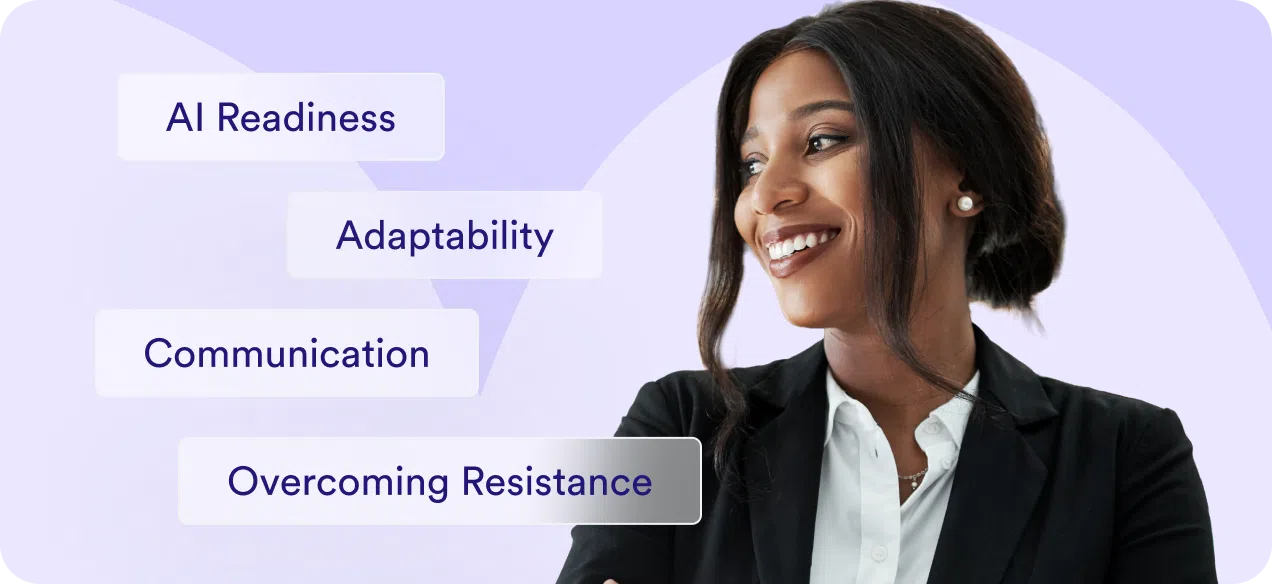
Based on Hone’s experience working with tens of thousands of managers, and supported by research from the World Economic Forum, McKinsey, Deloitte and Gartner, these are the skills supermanagers need on the human side.
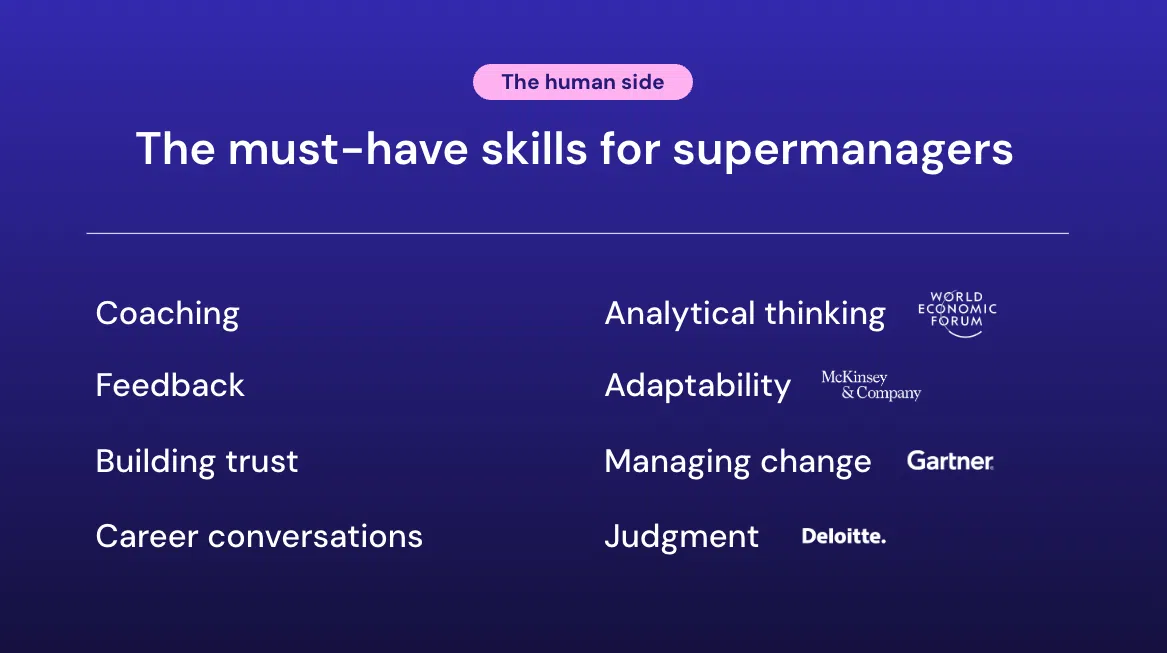
Coaching. Managers need to help people perform better, not just work faster. As teams navigate new tools and new expectations, coaching is the mechanism for doing that.
Feedback. The pace of change means managers need to give timely, useful feedback continuously, not save it for annual cycles.
Building trust. Fear of AI replacing jobs is real. Managers who build psychological safety create the conditions for their teams to experiment, share what isn’t working, and grow into new workflows without defensiveness.
Career conversations. As roles evolve, managers play a critical role in helping people understand what’s changing and where they fit. Retention depends on it.
Analytical thinking. The World Economic Forum’s 2025 Future of Jobs Report identifies analytical thinking as the top core skill for employers. Managers need it to evaluate which tools are actually worth adopting and how to prioritize what gets automated versus what stays human.
Adaptability. McKinsey’s 2025 Development in the Future of Work report highlights adaptability as essential for leaders navigating constant change, and the pace isn’t slowing down.
Managing change and ambiguity. Gartner’s 2026 HR Trends research notes that leaders who can “routinize change” see three times higher rates of healthy change adoption. Managers need to do this at the team level every week.
Judgment. Deloitte Insights called judgment the defining capability for modern managers. With AI making it easy to produce a lot of output quickly, the ability to assess quality and know what good actually looks like is more important than ever.
The AI side
The AI side of the supermanager equation has three levels: self, team, and organization.
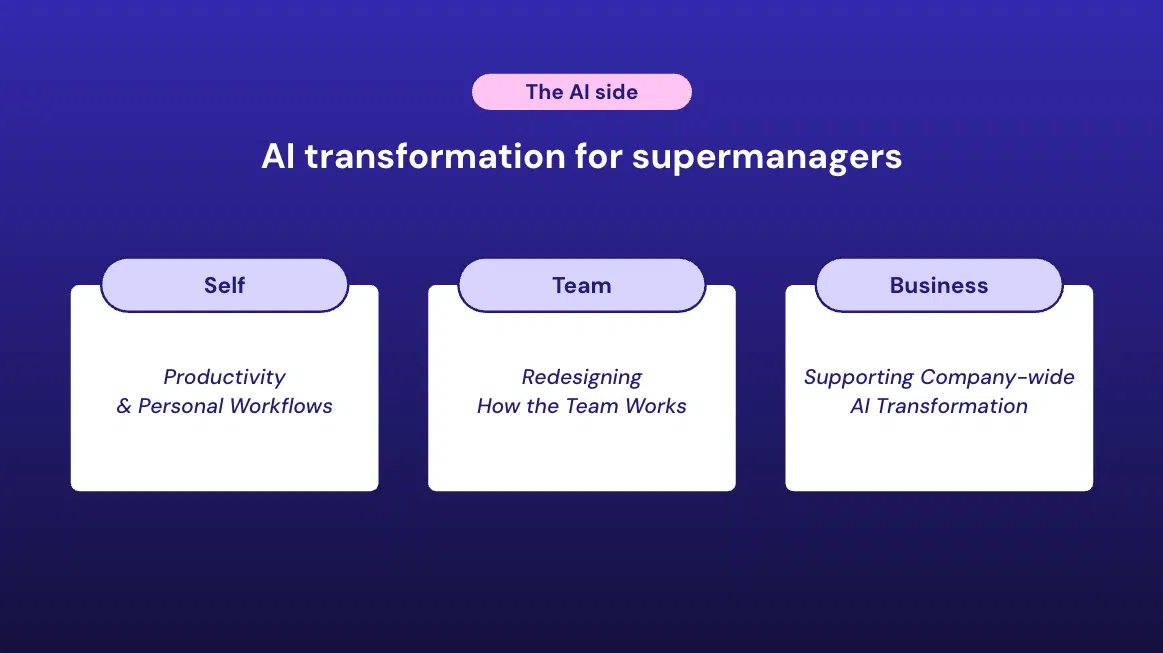
Self. Supermanagers use AI to improve their own work: summarizing, drafting, research, planning. But the bigger unlock is building repeatable workflows. Hone CEO Tom Griffiths uses an automated process that pulls from his meeting transcripts weekly and generates a list in Slack of commitments he has made and commitments others have made to him. It’s a small example of what’s possible when managers move beyond one-off AI use and start building systems.
Team. This is where supermanagers have their greatest leverage. The question isn’t just “how can I use AI?” It’s “how should our team work differently because of AI?” AI transformation consultant Dr. Markus Bernhardt describes this as the difference between the surface wave (new tools, pilots, experimentation) and the undercurrent (the deeper work of redesigning workflows and how decisions get made). Most organizations are stuck in the surface wave. Supermanagers are the ones who push their teams into the undercurrent.
Organization. At the business level, supermanagers are good actors in the company’s broader AI transformation. That means modeling responsible usage, contributing to shared prompt libraries and workflow repositories, and helping define what good looks like so that individual experimentation becomes institutional capability.
Why one-off training doesn’t build supermanagers
Most manager development programs were designed for the information age. They assume roles are stable, change is gradual, and a day-long offsite once a year is enough to move the needle.
None of that is true anymore.
The skills supermanagers need are evolving in real time. A framework that was relevant six months ago may already be outdated. One-time workshops create a spike of awareness and then fade. Generic content doesn’t connect to what a manager is actually dealing with on a Tuesday morning. And for most organizations, the scale problem makes it even worse. There are simply too many managers to develop with a model that doesn’t scale.
According to Bersin’s 2026 Guide to Corporate Learning, 74% of companies say they’re not keeping up with their organization’s demand for new skills. The gap isn’t awareness. It’s the ability to build capability continuously, at scale, in a way that actually changes behavior.
What does work: three pillars for building supermanagers
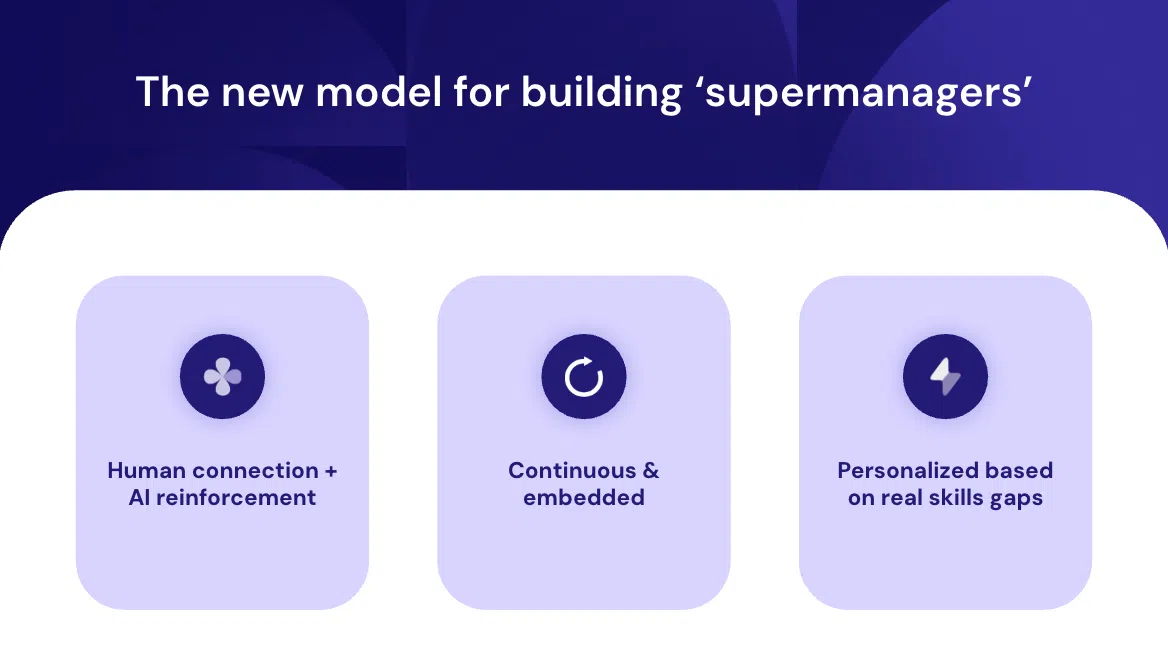
1. Human connection combined with AI reinforcement
The best way to develop supermanagers mirrors what supermanagers do: blend human-led experiences with AI-powered support.
Some things require humans. Accountability, nuanced coaching conversations, empathy, peer learning. These don’t translate to an AI tool. But AI is genuinely useful for on-demand knowledge, safe practice environments, in-the-moment reinforcement, and real-time feedback. The most effective development programs use both.
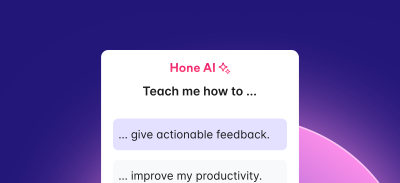
At Hone, this looks like pairing live, expert-led classes with AI experiences including voice-based role plays and an AI coach available in Slack and Teams. A manager preparing to give difficult feedback can practice the conversation with AI before it happens, then debrief afterward. The live class builds the framework. The AI experiences make it stick.
2. Continuous and embedded learning
Development that happens outside of work rarely transfers to work. Supermanagers need learning that’s woven into what they’re already doing.
That means building in reinforcement at the moment it matters: a nudge before a difficult one-on-one, a follow-up after a class, a prompt when a manager is about to apply something they just practiced. It also means building a cadence of development that keeps pace with how fast the environment is changing. A once-a-quarter training isn’t going to close the gap when AI is releasing new capabilities every few weeks.
Practical starting points: block time for experimentation. Some Hone customers have done company-wide AI learning days where teams showcase use cases to each other. Create a shared space for people to discuss what’s working and what isn’t. Make it normal for managers to share their AI workflows openly with their teams.
3. Personalized to real skill gaps
Not every manager needs the same thing. A manager who’s strong at coaching but struggles with change management needs a different development path than one who’s technically fluent but avoids hard feedback conversations.
The shift from broad, reactive training to targeted, personalized development is where the biggest efficiency gains come from. That requires visibility into actual skill gaps, not assumptions based on job title or tenure, but data on where individual managers are strong and where they’re falling short. With that picture, L&D teams can build interventions specific enough to actually change behavior, rather than deploying the same program to everyone and hoping it lands.
Where to start
Building supermanagers doesn’t require a full program overhaul on day one. A few places to start:
Audit your current model against these three pillars. Is your development continuous or episodic? Is it personalized or one-size-fits-all? Does it combine human and AI experiences, or rely entirely on one?
Identify the skill gaps that matter most right now. Analytical thinking, judgment, and change management are consistently rising to the top, but your organization may have specific gaps worth prioritizing first.
Give managers explicit time to experiment with AI. The number one thing L&D teams hear from managers is that they don’t have time. That means time has to be created, not found.
Start with a real pain point, not a use case. The managers who stick with AI adoption are the ones who experience a genuine improvement in their day-to-day work. Help them find that first.
The supermanager isn’t a distant aspiration. It’s a specific, buildable combination of skills, and it’s the profile your organization needs to get real value from AI transformation. The development model that gets you there looks different from what most teams have been running. But the shift is worth making.
Ready to build supermanagers at your organization?
Watch a recording of our recent webinar to take a deeper dive into building supermanagers at scale.


